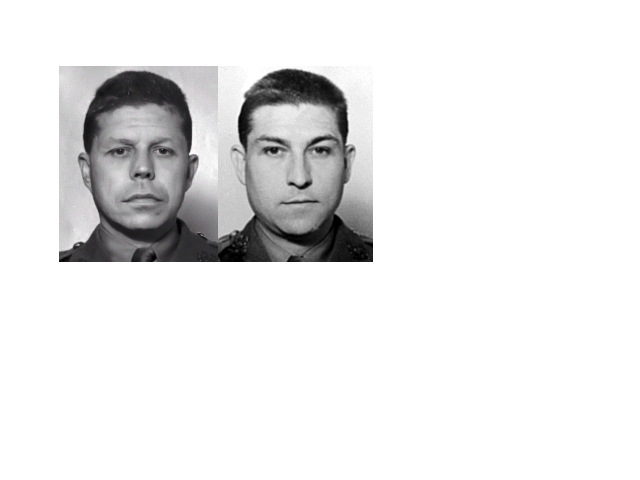
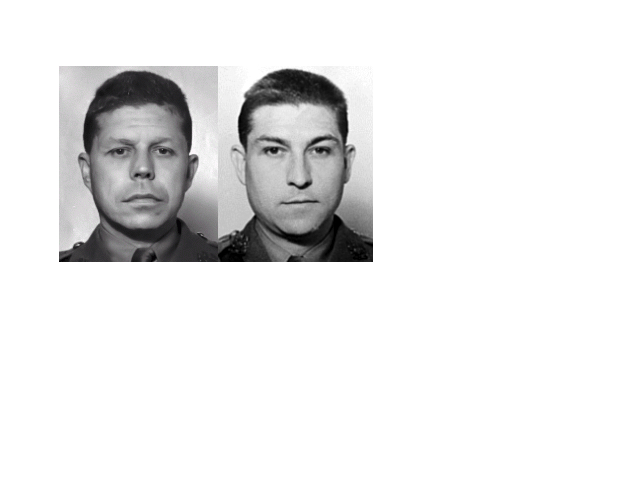
At SOE headquarters in London brothers Henry and Alfred Newton were affectionally referred to as the twins although there was a large age difference. Before joining SOE their parents, wives and children boarded a liner to take them and other refugees to the safety of England but during the passage the ship was sunk by a German U-boat and there were no survivors and after the loss of their entire family the brothers had a deep hatred of the Germans.
The twins were sent to France to train members of the resistance in the use of weapons and explosives, but the Gestapo eventually tracked down their safehouse in Lyon. Due to their reputation the Gestapo were accustomed to people cowering before them, and the 15 Gestapo officers who burst into their safe house were shocked when the twins immediately began attacking them with improvised weapons including wine bottles and chair legs being used as truncheons. By the time the twins were overpowered and severely beaten the Gestapo officers were bruised and bloodied and one had his front teeth knocked out.
After being taken to Gestapo Headquarters at Hotel Terminus in Lyon, for several days they were tortured by Klaus Barbie (the butcher of Lyon) and his equally psychopathic assistant Larsen but the twins refused to provide information. Barbie then put the twins before a mock firing squad where they showed no emotions and it was clear they were prepared to die. After failing to break the twins they were sent to a concentration camp where they survived by changing their prison numbers on their uniforms with prisoners who had died from typhoid and other diseases and this continued until they were eventually liberated. Although they survived the war the twins never got over their injuries and mental scars.
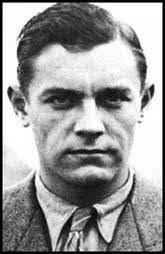
Peulevé undertook three missions to France and eventually formed a clandestine circuit called Author where he armed and trained more than 4000 members of the resistance. He was aware of being on the Gestapo wanted list but turned down an opportunity to be extracted from France by the RAF Special Duties Squadron.
Peulevé and several members of the local resistance were later arrested at a safehouse and eventually taken to the Gestapo headquarters in Paris where they were separated before being interrogated.
Peulevé was tortured for several days but refused to answer their questions and was transferred to a solitary confinement cell at Fresnes Prison. During an escape attempt he was shot in the leg and after being refused medical treatment was forced to remove the bullet by digging it out with a dirty prison spoon whilst hoping the wound would not become infected. He was later deported to a concentration camp and after eleven agents were executed and knowing he could be next he swapped his identity with a French prisoner named Marcel Seigneur who had died from Typhus. In early 1945 Peulevé, now known to the SS guards as Marcel Seigneur, was transferred to a labour detail where he was forced to dig anti-tank ditches near the River Elbe and after advancing American forces reached Magdenburg he managed to escape.
Several hours later he was stopped by two SS soldiers but managed to convince them he was a French collaborator trying to avoid the advancing Americans and then warned them to remove their tunics and insignias because the Americans were shooting members of the SS. As they began to undress Peulevé grabbed one of their pistols and later handed them over to soldiers of the 83rd US Infantry Division. After being debriefed he returned to England and landed at Croydon Airport on 18 April 1945.
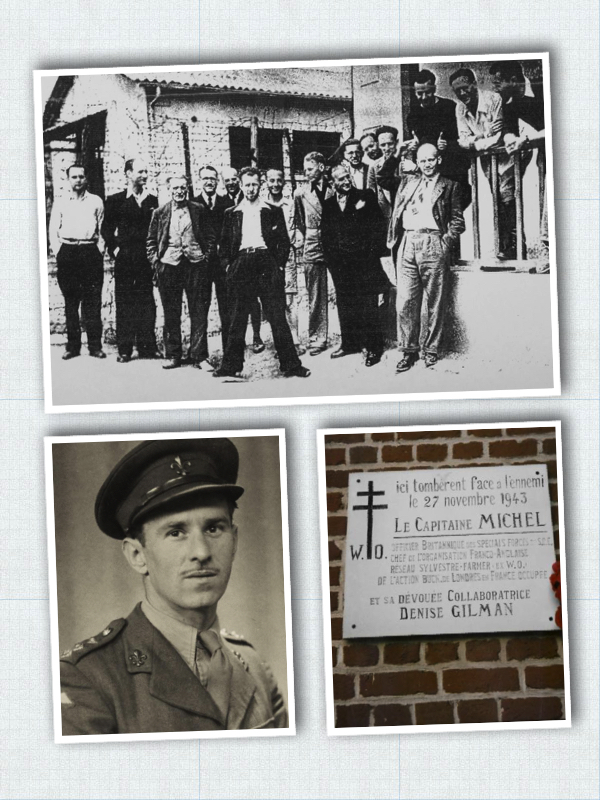
Michael Trotobas was known as a lively character with well-developed leadership skills. During his training in Scotland he got drunk and went Salmon fishing with explosives and whilst serving in France he was noted for going out in the middle of the night by himself and firing a burst from his Sten Gun to unnerved German troops. Trotobas volunteered for three missions to France, several months after arriving on his first mission he was arrested and was part of a mass prison breakout by SOE agents and members of the Resistance. (photo Trotobas with legs astride in prison) and during his second mission he distinguish himself as a resistance organiser and leader. In November 1943 he created the Farmer network with more than 800 resisters based in Lillie and led many sabotage operations and respectfully became known as ‘Capitaine Michel’. In February 1943 he organised the derailment of 40 trains and closed the railway for two days and over the following months Farmer attacked around 20 trains per week which created delays in supplying German forces in the Lillie region. On the night of 27/ 28 June 1943 with forged Gestapo identification papers Trotobas lead 20 men from the resistance dressed as gendarmes and talked his way into the Locomotives sheds in Lille, as well as damaging locomotives they destroyed four million litres of oil and damaged 22 transformers.
Instead of keeping a low profile Trotobas insisted on taking the same risks as those under his command and personally led many sabotage operations but was eventually denounced by a member of his network.
After his safehouse in Lillie was surrounded by German soldiers it was clear to Trotobas and his assistant, 23-year-old Denise Gilman, they were outnumbered, out gunned and there was no escape, but they decided to make a last stand against overwhelming odds. After a lengthy gun battle inside the flat Trotobas and Gilman were shot and a witnessed later described their bodies being thrown into the street as a deterrent to members of the resistance. Immediately after the death of ‘Capitaine Michel’ Farmer destroyed 11 locomotives at Tourcoing and continued sabotaging high value targets.
By the time France was liberated out of the 800 members of Farmer Circuit more than 300 had been killed in action, executed or disappeared after being transported to concentration camps.
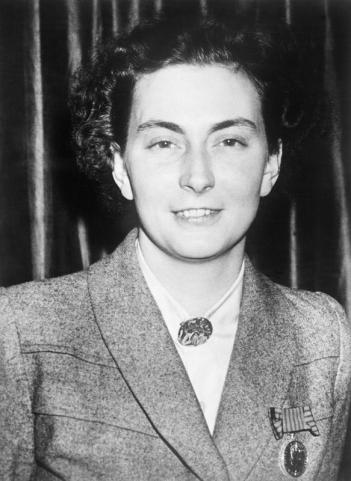
Andrée de Jongh grew up in a suburb of Brussels and after the emergency evacuation of Dunkirk she became aware British soldiers were being hidden by Belgium families and a man named Arnold Deppe was planning to escort them across France to neutral Spain and Andree decided she wanted to help. Neither were aware their early success would develop into the Comet Escape Line financed and supported by MI9 in London.
At the age of 24 Andrée escorted her first escapers: a young British woman and 10 Belgians wanted by the Gestapo but when they reached the River Somme, it was discovered six of the Belgians could not swim so Andrée made seven trips across the river swimming with only her legs and pushing the escapers on a rubber tyre. After returning to Brussels she was told Arnold Deppe had been arrested by the Gestapo and she was now in command.
Throughout the war Comet rescued down aircrews, political prisoners and British agents and although it was part of MI9 it was a network of families and friends. Its escape routes consisted of hundreds of Belgium citizens among which were the de Greef family who provided black market supplies and forged papers; 19-year-old Nadine Dumont, a Comet guide who survived ten-weeks of interrogations and two concentration camps and Andree’s father, Frédéric who was arrested at a Paris train station after being betrayed and later executed by firing squad. Around one thousand people worked in some capacity for the Comet Line and roughly 155 were killed and many others deported to concentration camps.
Andrée de Jongh personally escorted 118 escapers across the Spanish border which took over 33 trips. In 1943 part of the line was infiltrated by the Germans and Andree de Jongh was captured at a French safe-house. After being interrogated multiple times she was transported to Ravensbrück and then Mathausen concentration camp where she was liberated in April 1945.
After the war she was awarded the George Medal, the Belgian Croix de Guerre/Oorlogskruis and the US Medal of Freedom and was made a Chevalier in both the Order of Leopold and the Legion d’honneur, she also fulfilled her childhood dream of working as a nurse in Third World Countries. Andrée de Jongh died in 2007 at the age of 90
A brief overview of their war service in France during WW2
At SOE headquarters in London brothers Henry and Alfred Newton were affectionally referred to as the twins although there was a large age difference. Before joining SOE their parents, wives and children boarded a liner to take them and other refugees to the safety of England but during the passage the ship was sunk by a German U-boat and there were no survivors and after the loss of their entire family the brothers had a deep hatred of the Germans.
The twins were sent to France to train members of the resistance in the use of weapons and explosives, but the Gestapo eventually tracked down their safehouse in Lyon. Due to their reputation the Gestapo were accustomed to people cowering before them, and the 15 Gestapo officers who burst into their safe house were shocked when the twins immediately began attacking them with improvised weapons including wine bottles and chair legs being used as truncheons. By the time the twins were overpowered and severely beaten the Gestapo officers were bruised and bloodied and one had his front teeth knocked out.
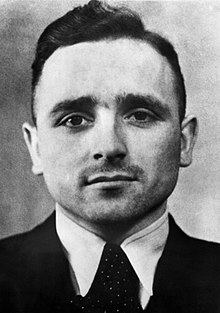
Klaus Barbie – the Butcher of Lyon
After being taken to Gestapo Headquarters at Hotel Terminus in Lyon, for several days they were tortured by Klaus Barbie (the butcher of Lyon) and his equally psychopathic assistant Larsen but the twins refused to provide information. Barbie then put the twins before a mock firing squad where they showed no emotions and it was clear they were prepared to die. After failing to break the twins they were sent to a concentration camp where they survived by changing their prison numbers on their uniforms with prisoners who had died from typhoid and other diseases and this continued until they were eventually liberated. Although they survived the war the twins never got over their injuries and mental scars.
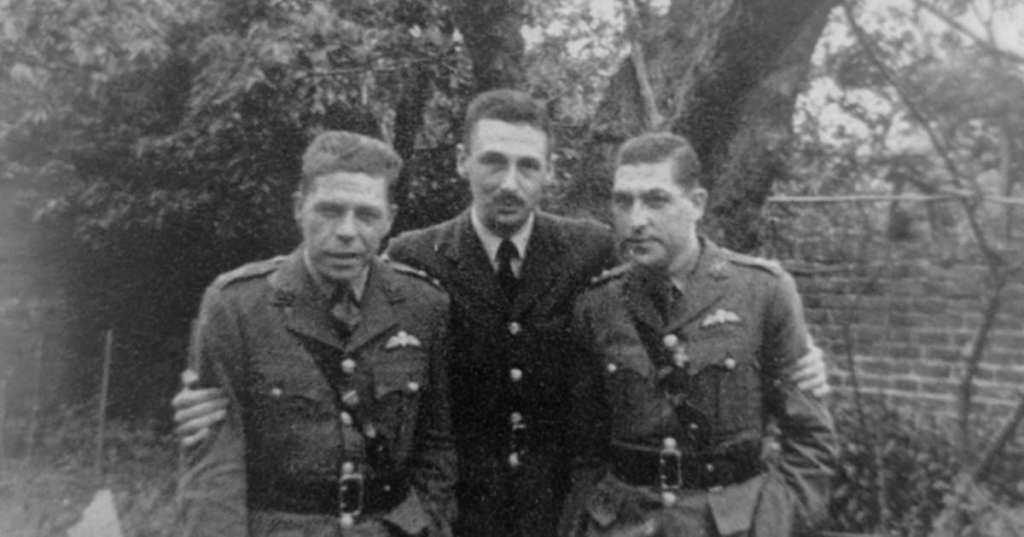
The twins. Photograph taken after the war (source unknown)
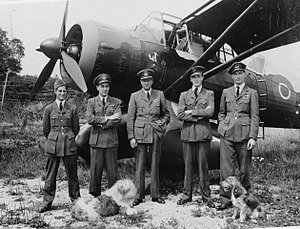
No.161 Special Duties Squadron RAF was responsible for supporting SOE and other agents working in occupied France and pilots flew alone in a slow, single engine Lysander aircraft which was unarmed and had an extra fuel tank bolted between the undercarriage to allow them to fly deeper into France and return to England. Pilots used moonlight to identify land marks whilst also watching out for night fighters and ground defences and had to find remote farmland to pick up or deliver agents.
When Hugh Verity was asked why he decided to make one pickup in pitch darkness and no moon he replied, “I wanted to see how frightening it was and that’s why I never did it again”. The truth is, he volunteered to take the mission after being told an SOE agent was attempting to escape the Gestapo and if he was not extracted he would very likely be captured, tortured then executed. Verity was the OC of ‘A’ Flight? and because it was not known whether it was possible to complete this sortie without moonlight and it was widely acknowledged it could be a one-way trip, due to the additional and unknown dangers Verity would not contemplate ordering one of his pilots to fly the sortie and decided to do it himself. After over eight-hours of fear and uncertainty Hugh Verity successfully rescued the agent.
No. 138 Special Duties Squadron supported SOE, MI6, MI9, the Free French and resistance movements throughout occupied Europe. Apart from dropping agents by parachute most of the weapons, sabotage stores and money to finance resistance arrived by parachute during moon periods and 138 Squadron was base at RAF Tempsford near Sandy Bedfordshire.
Flying Officer Reginald Lewis Halifax Observer/bomb-aimer
My trips from Tempsford involved going down to the south of France, a couple of trips to Norway and one in Germany itself. That one always surprises me, because we had an agent dressed up in a German uniform.
The squadron was operating as far as Poland and that was quite a long flight in wartime conditions, from the UK up to somewhere like Warsaw was something like fifteen hours. Apart from the danger of the flight itself it was almost at the complete endurance of a Halifax. They just couldn’t hold any more octane. And a couple of crews were lost, particularly over the Baltic, to night fighter attacks.
Squadron Leader Frank Griffiths Halifax Pilot
Polish crews joined us… and they were marvellously aggressive… The British would come back the proper way as briefed, but you’d be very surprised to come back and find that the Poles were about an hour ahead of you, because they’d come back through the middle of Germany, and they never had a bullet left. Having got rid of the packages to be dropped or the men, they would go on a shoot-up in Germany. And, of course, in many places the aircraft got hit and then we had to repair them…. You couldn’t help but admire them… They were wonderful chaps. There was no turning back with the Poles.
Wing Commander Ken Batchelor Halifax Pilot
People were attacked, intercepted, here and there. I did a dog-leg to avoid the German airfield near Caen and of course flew right over the bloody airfield and we were at nought feet. It was very interesting over the housetops with tracer bullets horizontal over and under your wings.
Pilot Officer John Charrot Halifax observer/bomb aimer
In France they had these trains which were usually carrying troops… but you couldn’t tell that on the back they had a gun, a flak gun, and this night we didn’t pick it up and they started firing. But Terry, from the rear turret was so quick that he knocked it out before much damage had been done until we heard the dispatcher screaming over the intercom, ‘All the joe’s {agents} are hit and the aircraft is riddled with holes.’
During the same interview Frank Griffiths who was the pilot added:
As a matter of fact, the expression he used was, ‘It looks like a butcher’s shop in the back.’ None of the RAF crew were hurt, fortunately, but we turned around and came back…. After we landed the petrol was still pouring out of the aircraft and the medical officer on the station sent the casualties off to hospital. Then a medical orderly who’d been told to clean up all the syringes and things we’d used in our first aid kit, found the ear of a man… and the ear was packed in ice, rushed down to the hospital and sewn on and it was quite ok, he got his ear back. I don’t know what his hearing was like, but it was quite a gory job.
Squadron Leader Frank Griffiths Halifax Pilot
I was to drop this load off just north of Annecy, about halfway between Annecy and the Swiss town of Geneva. Most of the equipment, military equipment, was for the Plateau des Gliéres, this very high plateau, which was an excellent place for the Maquis {French Resistance} to hide out… On the third trip one engine failed. At first it sounded like fuel starvation. I wasn’t over worried. Slapped it into coarse pitch, which means less drag, and the flight engineer started to try and sort things out… we seemed to be doing quite well on three {engines} and even climbed a bit. Then {we} turned around and came back…. There’s nothing worse than having a four-engined bomber that won’t climb in the bottom of an Alpine valley in the middle of the night, even if it is a full moon.
The next thing that happened was the other engine on that wing went. That’s no.2 engine… I sent the crew to crash stations and then we hit the first house. In fact, the last thing the dispatcher said to me over the intercom was, ‘All Ok, skipper. Crews to crash stations.’ That was actually the last spoken message. Before that, this chap McKenzie, the co-pilot, who’d merely come for the trip because he was so keen, had wrestled with the escape hatch over my head and got that off. Then the aircraft broke up and I got shot through this hatch and partly through the window screen with my seat attached and about a good hundredweight of thick steel armour plating behind.
I ended up in telephone wires between two poles. Meanwhile the aircraft had crashed, and the crew were killed, though I believe Maden, the dispatcher did get as far as the hospital in Annecy and then died. It’s hard for me to say exactly what went on. There was a tremendous fire…
As with all countries under German occupation, in France the Abwehr (German Military Intelligence) and the Gestapo employed huge resources to track down wireless operators. Apart from resistance movements being unable to function without arms, explosives and other support which could only be obtained through wireless links to London, Hugo Bleicher who was a senior non-commissioned officer with the Abwehr and responsible for crushing resistance in France, said they regarded wireless operators as a rich source of intelligence because they had knowledge of every message and orders received from London.
Hugo Bleicher
The headquarters of the French Section in London were aware of the dangers facing their agents and those volunteering for wireless training were told their chances of survival, with a bit of luck, was six-weeks and if captured they would very likely be tortured by the Gestapo for their personal codes which could be used by a German operator to ‘play-back’ their wireless to London. Only later did the section become aware ‘play-back’ had been used by the Germans with great success in the Netherlands and many agents along with members of the resistance had been killed or transported to concentration camps where they were later executed. (information about the Dutch section will found at the link provided)
Jacqueline Nearne, former courier with SOE French seen in the public information film ‘School for Danger: Now the truth can be told’ which was produced after the war.
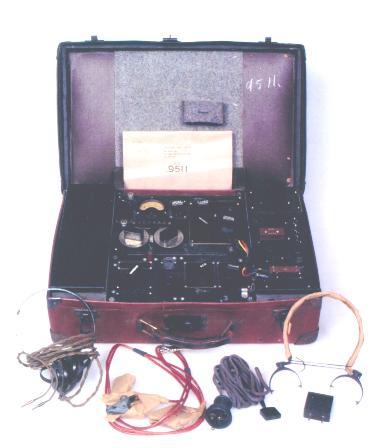
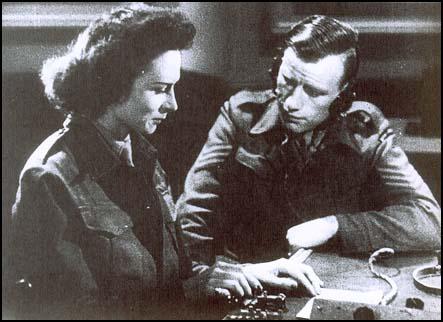
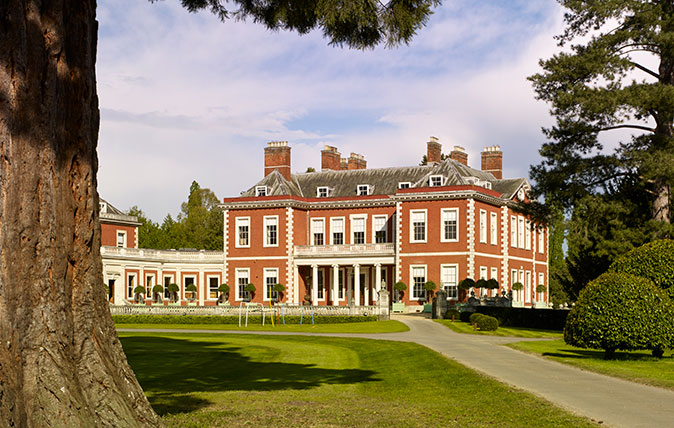
Agents volunteering for wireless duties were sent on a technically challenging course at the Wireless and Security School and the two main establishments were located at Fawley Court in Henley-on-Thames and Thames House in Oxfordshire. Apart from learning to send and receive Morse Code at a sufficient speed they needed to understand radio wave propagation, the use of cyphers and learn how to repair their wireless in the field. They also needed to prove their competence in the use of various security measures intended to make it difficult for German direction finders pin-pointing the safe houses they were using whilst in contact with London.
A recent photograph of Fawley Court
When wireless trained agents arrived in France their first task was to find several suitable locations from which to use their transmitter to pass messages to London as quickly as possible whilst ensuring they never stayed on the air for over twenty-minutes, but for a variety of reasons some operators broke the twenty-minute rule and did not survive the war.
It was not long before the Germans introduced radio jammers which apart from making it difficult to send and receive messages they were also intended to force operators to remain longer on the air to pass messages.
Information about the Wireless War against SOE D Section (Dutch)
In 1940 after SOE decided they needed a clandestine naval section to support their agents in France they quickly became aware finding officers and men with the essential seamanship skills and experience would be difficult. They needed men who could quietly navigate rocks and sandbanks close to enemy shores in pitch-darkness and without the aid of moonlight.
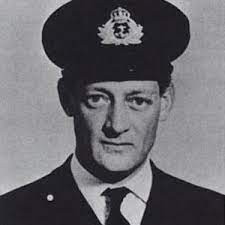
Through their network of discreet contacts SOE was given the name of Gerry Holdsworth and discovered he had all the qualifications they were looking for in a commander: whilst working for D Section SIS (MI6) he used a small yacht to reconnoiter the Norwegian coast and whilst operating at night and close to the shore he frequently navigated the various hazards.
After being approached by SOE to command their naval section he accepted the appointment and he along with his wife who had also served with D Section established the flotilla on the Helford Estuary at Port Navas in Cornwall.
Those he recruited included Fishermen with extensive experience of the enemy coast and former smugglers which one officer described as the buccaneer type who if they overheard we needed something they would go out and pinch and it would suddenly appear on the quay. Apart from transporting agents to and from Brittany they also delivered weapons and sabotage stores and rendezvoused with French fishing trawlers and loaded them with Tuna packed with explosives, detonators and timing devices.
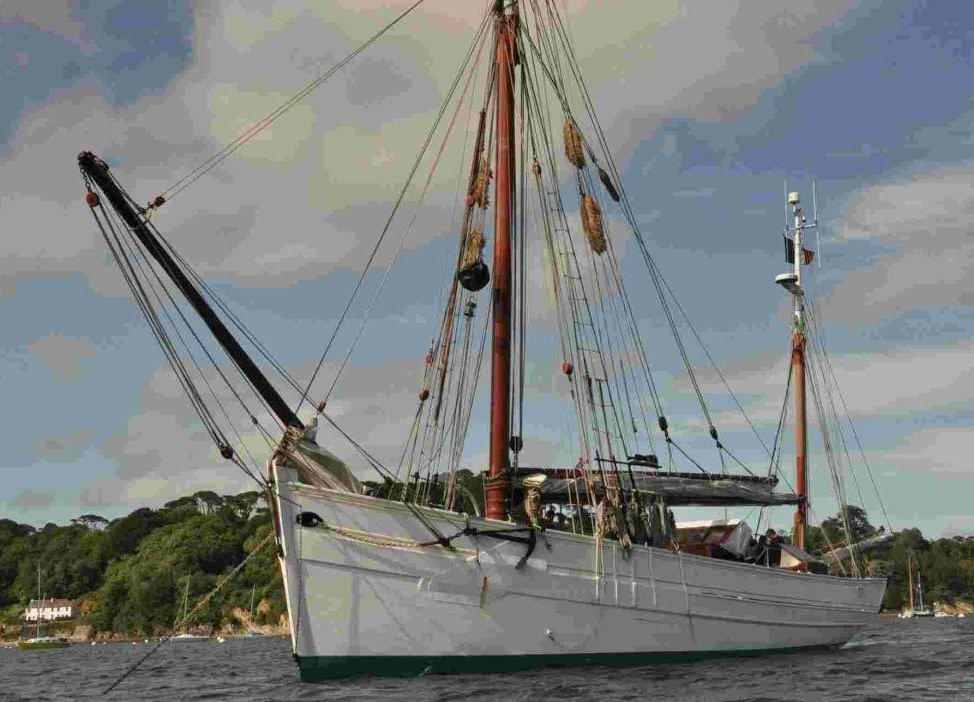
The Mutin
One new recruit who previously served as a quartermaster with the Royal Navy later recalled, “On my arrival at the quay I saw heaps of sails on the deck covered in blood. Shipwrights were digging out shrapnel from bow to stern and I thought to myself God what have I let myself in for! … I was later told, after dropping off an agent the Mutin {name of vessel} was spotted by a German aircraft and raked by cannon fire during which the engineer was killed…”
Harry Peulevé undertook three missions to France and eventually formed a clandestine circuit called Author where he armed and trained more than 4000 members of the resistance. He was aware of being on the Gestapo wanted list but turned down an opportunity to be extracted from France by the RAF Special Duties Squadron. Peulevé and several members of the local resistance were later arrested at a safehouse and eventually taken to the Gestapo headquarters in Paris where they were separated before being interrogated.
Peulevé was tortured for several days but refused to answer their questions and was transferred to a solitary confinement cell at Fresnes Prison. During an escape attempt he was shot in the leg and after being refused medical treatment was forced to remove the bullet by digging it out with a dirty prison spoon whilst hoping the wound would not become infected. He was later deported to a concentration camp and after eleven agents were executed and knowing he could be next he swapped his identity with a French prisoner named Marcel Seigneur who had died from Typhus. In early 1945 Peulevé, now known to the SS guards as Marcel Seigneur, was transferred to a labour detail where he was forced to dig anti-tank ditches near the River Elbe and after advancing American forces reached Magdenburg he managed to escape.
Several hours later he was stopped by two SS soldiers but managed to convince them he was a French collaborator trying to avoid the advancing Americans and then warned them to remove their tunics and insignias because the Americans were shooting members of the SS. As they began to undress Peulevé grabbed one of their pistols and later handed them over to soldiers of the 83rd US Infantry Division. After being debriefed he returned to England and landed at Croydon Airport on 18 April 1945.

 Alan Malcher