Baker Street London W1 during the Second World War

SOE

This plaque will be found outside 64 Baker Street London W1. This plaque marks the former HQ of SOE (CD). Most of the office space in Baker Street accommodated SOE Country Section HQ’s which have no plaques and their wartime use has mainly been forgotten. 83 Baker Street, for example, was the HQ of the French Section.

Alan Malcher

The German wireless deception leading to the deaths of three SOE agents sent to France.

France AntelmeLionel leeMadeleineDamerment

AUTHORS NOTE- there are several conflicting accounts and inconsistencies will be found in several official documents which are explained in my forthcoming book.

On the night of 28/29 February 1944, SOE agents France Antelme on his third mission to France, wireless operator Lionel Lee and Madeleine Damerment arrived by parachute near the city of Chartres to start a clandestine circuit called Bricklayer.

It is now believed sometime in late 1943 Canadian agents Frank Pickersgill and Ken Macalister had been arrested during which their wireless and codes were found, and a German operator started playing back their set and because the correct codes were being used no suspicion was raised in London. It was the Gestapo, not the Canadian agents who requested these agents be sent and consequently were dropped to the waiting Germans.

From the post war investigation, we see Antelme was furious and began fighting the Gestapo officers before eventually being restrained and the three agents were taken to Avenue Foch, Gestapo Paris HQ where Antelme refused to talk whilst being tortured. Antelme and Lee are recorded as being executed at Gross Rosen Concentration Camp in Lower Silesia and Madeleine Damerment along with three other female SOE agents were transported to Dachau in Germany where they were forced to kneel before being shot through the base of their necks. Canadian agents Pickersgill and Macalister along with several other SOE agents were executed by slow strangulation with piano wire suspended from hooks in the crematorium at Buchenwald concentration camp sometime in February 1944.

Also see SOE Agents Frank Pickersgill and Ken Macalister    Canadian SOE Agents Frank Pickersgill and Ken Macalister – Alan Malcher

Alan Malcher

SOE Wireless Station in England

Home station SOE Alan Malcher

British Homefront during WW2. Home Station was the name given to the wireless station in England which maintained contact with SOE agents throughout occupied Europe. Over 500 people, mainly women, worked at the station and these wireless operators were often the first to suspected there was something wrong: the agent under their charge was working under stress or their wireless set was being used by a German operator. Aware enemy forces were attempting to find their agents through direction finders these wireless operators ensured their agents did not stay too long on the air and did not ask them to repeat unreadable messages. No date (IWM)

Alan Malcher military historian

Leo Marks head of SOE Codes and Cyphers

marks

Left: Leo Marks (24 September 1920 to 15 January 2001) the head of SOE’s codes and cyphers based at Michael House Baker Street, London. Right: his adversary in the Netherlands Abwehr (German Military Intelligence) Lieutenant Colonel Herman Giskes who was responsible for the wireless deception resulting in many SOE agents from the Dutch Section and members of the resistance being captured and executed. People who knew Marks said his brain was wired differently and could workout complex problems and it was Marks who discovered the Abwehr wireless deception alternatively called the ‘wireless game’ and ‘Englandspiel’ (England Game). (Photos IWM)

Further reading    Dutch Resistance 1941-43: SOE’s Greatest Disaster in occupied Europe – Alan Malcher

Alan Malcher military historian

Sergeant Hugo Bleicher of the Abwehr: responsible for crushing resistance in France.

Hugo Bleicher. Alan Malcher SOE

Hugo Bleicher was a sergeant with the Abwehr stationed in France. Despite his rank Bleicher was responsible for crushing resistance throughout France and due to his ruthless approach and high success rate was supported by senior officers in the Abwehr. SOE agents and members of the resistance who were tracked down and arrested by Bleicher were handed to the Gestapo and were tortured for information, eventually executed or sent to concentration camps.

Bleicher used the cover names Colonel Henri, Jean Verbeck and Jean Castel. After the war Bleicher insisted he was not aware the prisoners he handed to the Gestapo would be tortured and executed but Colonel Maurice Buckmaster who was the Commanding Officer of SOE’s French Section rejected this claim and accused him of being an arrogant upstart and a war criminal. Hugo Bleicher also gave evidence against former members of the Abwehr and until his death in 1982 Bleicher ran a tobacconist in Tettnang, Germany.  (Photo IWM)

Alan Malcher military historian

Mary Lindell MI9 during WW2 describes her escape from the SD (Gestapo) after being sentenced to death.

The Sicherheitsdienst (SD), Sicherheitsdienst des Reichsführers-SS Security Service of the Reichsführer-SS was closely connected with the Gestapo and documents of the period often refer to both as the Gestapo.

Special Operations Executive (SOE) agent Odette Churchill (nee Sansom)

sansom2

SOE agent Odette Sansom (she married Peter Churchill after the war) was a single mother with three young children in England when she was arrested by the Abwehr and eventually handed to the Gestapo. During their attempt to force her  to talk Sansom was repeatedly burnt on the back with a red-hot poker and each time she fainted from the pain was revived with buckets of cold water being thrown over her so the torture could continue. When burning failed to break her all her toenails were pulled out but Sansom still refused to give the Gestapo information about her wireless operator who was in hiding and after the war Sansom reluctantly admitted to a journalist she was willing to die rather than answer their questions. Sansom then survived the ill-treatment and horrors of Ravensbrûck Concentration camp and after the war was awarded the GC which she always insisted was not awarded to her personally but represented all those alive and dead, known and unknown who fought for the liberation of France.

Odette

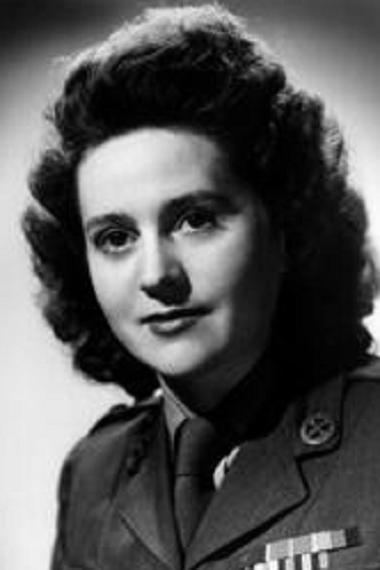
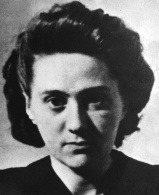
Violette Szabo: Special Operations Executive (SOE) in France

During her second mission to France Violette Szabo was captured after a fire fight with troops from 2nd SS Panzer Division Das Reich after being stopped at a roadblock outside Salon-la-Tour during which she expended eight magazines from her Sten submachine gun. Due to confusion the story of her firefight has been revised several times. According to the citation for the GC she was surrounded in a house and fired from windows during which she killed and injured several German soldiers.

After her capture she was interrogated at Gestapo (SD) headquarters at Avenue Foch in Paris and later transported to Ravensbrûck concentration camp. On 5 February 1945, at the age of 23, Violette Szabo, who had been sentenced to death, was shot through the back of the neck.

In 1946 her daughter Tanya was taken to Buckingham Palace by her grandparents to receive her mother’s posthumous GC (George Cross) from the King.

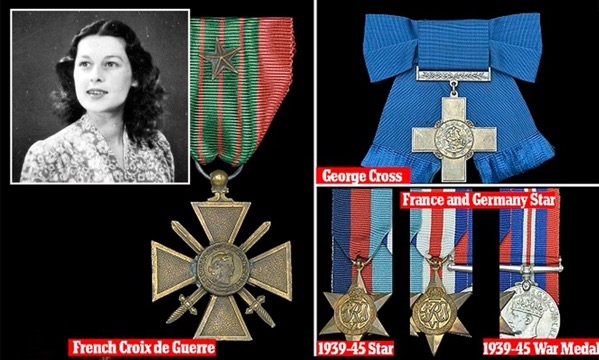
Violette and Tanya Szabo

Medals

Citation for the GC

St. James Palace, SW1. 17 December 1946
The King has graciously pleased to award the George Cross to:-
Violette, Madame SZABO (deceased), Women’s Transport Service (First Aid Nursing Yeomanry)

Madame Szabo volunteered to undertake a particularly dangerous mission in France. She was parachuted into France in April 1944 and undertook the task with enthusiasm. In her execution of the delicate researches entailed she showed great presence of mind and astuteness. She was twice arrested by the German security authorities, but each time managed to get away.

Eventually, however, with other members of her group, she was surrounded by the Gestapo in a house in the south-west of France.

Resistance appeared hopeless but Madame Szabo, seizing a Sten-gun and as much ammunition she could carry, barricaded herself in part of the house and, exchanging shot for shot with the enemy, killed or wounded several of them. By constant movement, she avoided being cornered and fought until she dropped exhausted. She was arrested and had to undergo solitary confinement. She was then continuously and atrociously tortured but never by word or deed gave away any of her acquaintances or told the enemy anything of any value. She was ultimately executed. Madame Szabo gave a magnificent example of courage and steadfastness.

Operation Cadillac 14 July 1944: SOE and the French Resistance

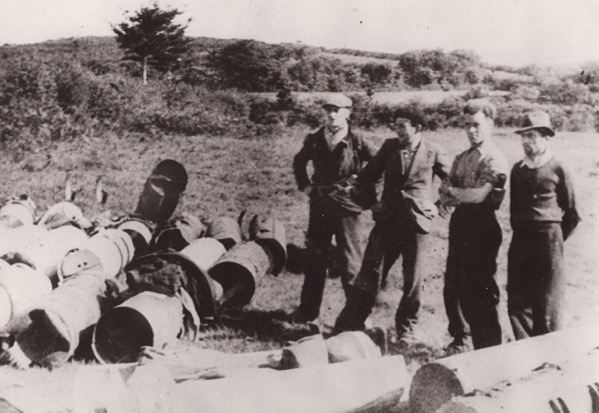
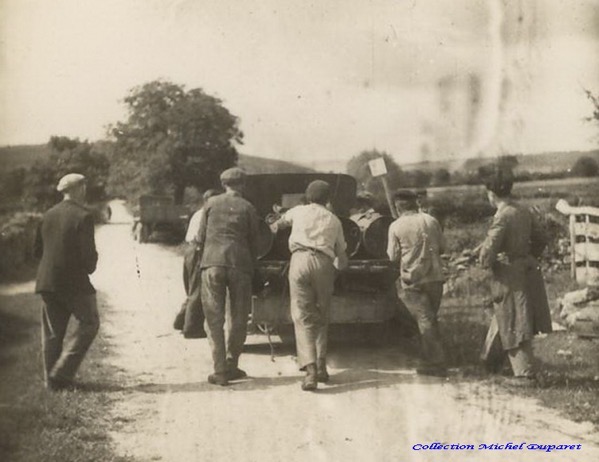
On 10 June 1944 the Special Operations Executive (SOE) and other Resistance Networks were told to find suitable large and remote fields for mass daylight parachute drops of weapons and other stores.

Parachutage armement résistance

The first daylight drop of weapons and stores was called Operation Zebra on 25 June 1944 when 180 B-17 bombers of the USAAF with fighter escorts dropped 2,160 containers to SOE and members of the Resistance at Ain, Jura, Haute Vienna and Vercose and due to its success a larger drop by Allied aircraft called Operation cadillac took place on 14 July 1944.

Cadillan

Operation Cadillac consisted of 349 bombers (mostly B17’s) with 534 Allied fighter escorts during which 3,791 containers loaded with 417 tons of weapons were dropped at seven locations. (Photos Musee de la Résistance)

SOE Polish Section (EU/P) Wladslaw Wazny in France

Apart from Krystyna Skarbek, GM (aka Christine Granville) who served with SOE’s French Section several Polish men and women also served with SOE EU/P in France, but this section is less well documented, consequently, there is much we don’t know about Wladyslaw Wazny and several claims about his war service are not supported by primary sources.

It is believed Wladyslaw Wanzy also known as Wladyslaw Rozmus was born on 3 February 1908 in the village of Ruda Rozaniecka to a peasant family and trained as a teacher and in 1934 was a Second Lieutenant in the Polish Army Reserve. At the start of the Second World War he was a platoon commander with the 39th Lwów Rifles Infantry Brigade and after the occupation of Poland he escaped to France and reached England via Spain and Gibraltar where he was later recruited by SOE.

It has been claimed but not confirmed, he infiltrated France in March 1944 and sent London the location of 59 V1 and V2 rocket launch sites which were later destroyed by Allied bombers. Although it is known Wazny was killed shortly before France was liberated there is still confusion regarding events leading to his capture and death.

Wladyslav Wazy SOE

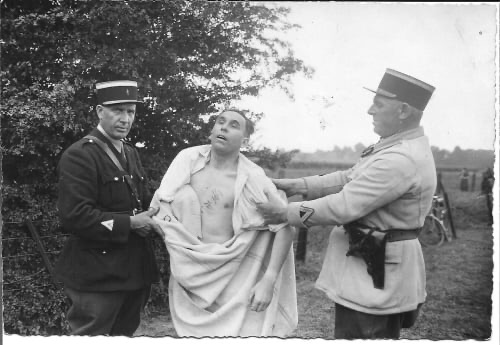
Wladslaw Wanzy after his arrest

Various theories about his capture and death

Some claim he was shot whilst attempting to escape, others say he was shot several times after shooting several Gestapo officers but was still alive. It has also been claimed that in July 1944 the Abwehr discovered members of his network and located their wireless operators with direction-finders and this led to his capture.

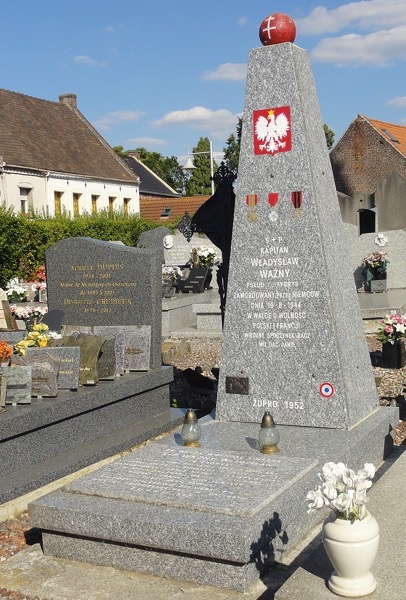
A further claim states that on 19 August 1944 the Abwehr and Milice raided the last of his safe houses which was a Tailor shop in the town of Montigny-en-Ostrevent and there are also various accounts of what happened next. Some say Wazny was involved in a shoot-out with German soldiers and the Milice after being surrounded and was hit by several rounds from a submachine gun, another version states he was shot in the leg as he climbed over a garden wall to escape. Whatever the story, as can be seen by the photograph of him in police custody he was captured alive and was later killed and buried in the cemetery of Montigny-en-Ostrevent, France.

800px Montigny en Ostrevent Cimetière de l église Saint Nicolas 03 tombe de Władysław Ważny