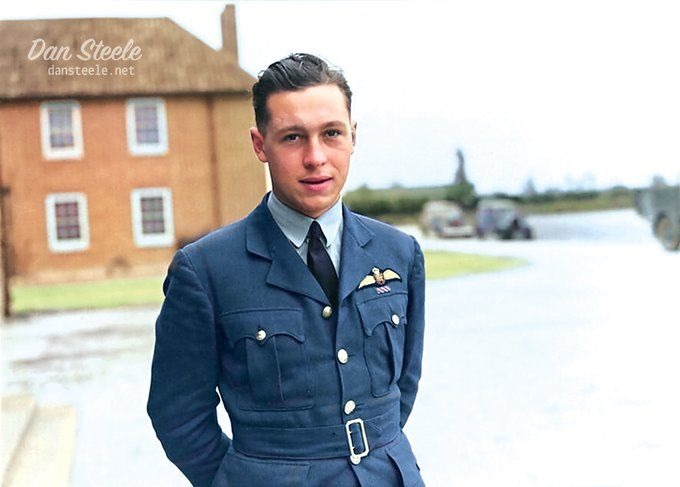
SOE Circuit Organiser Alfred Wilkinson

Alfred Wilkinson. Circuit organiser serving with the French Section SOE

Alfred Wilkinson had duel nationality British/French and was born in Paris and left his wife and young child in France to join the British Army.

Wilkinson parachuted into France on 5 April 1944 to organise the Historian circuit in the Orléans area where his wife and young child were still living, and SOE documents described it as “an area where German repressive measures had effectively checked all previous attempts to develop a resistance network. After receiving arms and other war materials by parachute Wilkinson and his Historian circuit prepared for large scale sabotage for D-day and by 6 June (D-day) the railway lines and telecommunication targets his circuit had been ordered to sabotage had been destroyed and added to the major disruption of the German military caused by other circuits.

It is known Wilkinson was captured towards the end of June at Olivet a commune in the Loiret department in north-central France and for the first fortnight was kept at the Eugéne Prison in Orléans. He was then taken to Frésnes Prison outside Paris where he was described by other SOE prisoners as looking well and Wilkinson was among a large batch of SOE agents and resistance fighters taken from Frésnes to Buchenwald concentration camp to be used as slave labour.

On 24 August Allied aircraft bombed the Gustloff armament factory outside the camp where many prisoners were forced to work. Several bombs hit the SS barracks killing 8 and injuring 300 SS soldiers and many prisoners. It was later said that in retaliation for the air raid the camp commandant Obersturmbannfuhrer Herman Pister ordered the execution of all British and French ‘terrorists.’

Seven prisoners were executed on 14 September and on 5 October more prisoners including Alfred Wilkinson were executed and according to a post-war investigation before being hung the men stood rigidly to attention whilst shouting ‘long live France. Long live England.’

Notorious Hermann Pister. Image taken after being arrested by American forces.

After the war Pister was convicted of war crimes and sentenced to death but died of a heart attack before being hung.

Yolande Beekman (nee Unternahrer) SOE Wireless Operator: French Section

Yolande Beekman

Yolande Unternahrer was born in Paris to a Swiss family in 1911 and moved to London as a child.

After the declaration of war in 1939 she enlisted into the Women’s Auxiliary Air Force (WAFFs) where she trained as a wireless operator. Due to her language skills, she spoke fluent English, French, German and Italian, Yolande came to the attention of the Special Operations Executive and whilst attending the wireless and security school to become a wireless trained agent that required skills not found in other branches of the military she met a trainee wireless operator named Jaap Beekman who was serving with the Dutch Section of SOE. Shortly after they married, on the night of 17/18 September 1943 Yolande Beekman parachuted into France to join the Musician circuit in Saint-Quentin in the department of Aisne as their wireless operator.  

It is known Yolande Beekman was in regular contact with London and arranged the delivery of over 20 parachute drops of weapons, ammunition, and explosives before breaking wireless security procedures: it was later said Beekman transmitted from the same location, on the same frequency and on the same three days of the week and was eventually located by German direction finders. Beekman along with her circuit organiser Gustave Biéler were arrested at the Café Moulin, Saint-Quentin on 13 January 1944.

At Gestapo Headquarters in Saint-Quentin both were tortured but refused to provide useful information. Beekman was then taken to Gestapo Headquarters at Avenue Foch in Paris and was later sent to Frésnes Prison near Paris and shared a cell with a nurse called Hedwig Muller who had been arrested by the Gestapo and after the war said Beekman seldom left her cell because her legs were weak and her leg injuries are thought to have been caused through torture.

At Frésnes there were three other SOE agents: Madeleine Damerment, a courier with Bricklayer circuit; Elaine Plewman who worked as a courier with Monk circuit and Noor Inayat Khan a wireless operator assigned to the ill-fated Prosper/Physician circuit.

Elaine Plewman, Yolande Beekman, Madeleine Damerment, Noor Inayat Khan

At 01:30 hrs on the morning of 10 September 1944 the women were handcuffed and taken to a railway station and eventually arrived at Dachau Concentration Camp. On 13 September Obersturmbannfuhrer Fredrich Wilhelm Ruppert executed the three women and after the war a member of the Gestapo named Christian Ott gave the following statement to American investigators:

“The four prisoners had come from the barrack in the camp where they had spent the night, into the yard where the shooting was to be done… The death sentence was announced to them…. The German speaking English woman {Beekman} had told her companions of the death sentence. All four had grown very pale and wept… Beekman {he called her the major!} asked whether they could protest against the sentence. The Kommandant declared that no protest could be made against the sentence. The major (Beekman) had then asked to see a priest. The camp Kommandant refused on the grounds that there was no priest in the camp.

The four prisoners now had to kneel with their heads towards a small mound of earth and were killed by two SS, one after another shot through the back of the neck. During the shooting the two English women held hands and the two French women likewise. For three of the prisoners the first shot caused death, but the German speaking English woman (Beekman) a second shot had to be fired as she still showed signs of life after the first shot.

After the shooting of these prisoners the Lagerkommandant said to the SS men that he took a personal interest in the jewellery of the women and that this should be taken to his office.”

It was also later stated the four women had been badly beaten before their executions.

SS Officer Wilhelm Ruppert. Image taken after being arrested by American forces.

After the war SS Officer Wilhelm Ruppert who was in charge of executions at Dachau was convicted of war crimes and executed by hanging.

The Tyburn Tree in Central London

Stone memorial

This stone plaque called ‘Tyburn Tree’ will be found on the large traffic island on Edgeware Road near Marble Arch in London and is one of many historical reminders of London’s dark history which often goes unnoticed. Though called the ‘Tyburn Tree’ there was no tree at this location and refers to the name given to a wooden scaffold used for public executions which could accommodate three prisoners at a time. From 1196, the first recorded execution, to 1783 this part of London was open countryside and hangings were considered popular entertainment. For instance, when highwayman Jack Sheppard was executed, there is said to have been an excited crowd of around 200,000.
Two expressions used during this period continue to be in popular use: “one for the road”, originally meant the last pint of ale before the condemned was transported by cart to Tyburn with excited crowds following them, also associated with alcohol is the expression ‘hangover’. Public hangings were abolished in 1868.

Alan Malcher.

Flight Lieutenant Eugene Seghers (Belgium) RAF (VR)

British Homefront during WW2.

Belgium fighter pilot Eugene Seghers RAF (VR). His memorial plaque in Walden Uckfield, East Sussex states: “Flight Lieutenant Seghers took off in his Spitfire from RAF Deanland to intercept V1’s (Anti-driver patrol) South of Uckfield. He failed to destroy a Doodlebug after intense cannon fire, its engine cut out, meaning that its terrible descent towards the town was imminent. Flight Lieutenant Seghers courageously attempted to deflect the high explosive flying bomb away from Uckfield using his aircraft’s wing. Near this location at 14:22 he made contact with the bomb causing it to detonate, destroying the Spitfire and killing the brave airman instantly. Sub Alis Gloria” (Under Wings of Glory) 26 July 1944.

Alan Malcher.

Operation Dynamo: The Evacuation of Dunkirk 27 May to 4 June 1940

Royston Colour

A colourised black and white image by Royston Colour of British soldiers in Dover after being evacuated. Image dated June 1940.

Lysander 161 Special Duty Squadron RAF

Part of the Shuttleworth Collection. The Lysander with distinctive extra fuel tank bolted between its undercarriages to allow the aircraft to fly deep into occupied France and return to RAF Tangmere during ‘pickup’ operations (delivering and extracting SOE, MI9, SIS, RF agents). Also distinguishable by the matt black fuselage and underside of wings to allow the aircraft to blend in with the moonlit sky and tops of wings camouflage to blend in with the ground when night fighters approached from above.

Alan Malcher

Nancy Wake SOE courier in France

Nancy Wake GM, Officer of the Legion of Honour (France), Medal of Resistance (France), Medal of Freedom (USA). SOE agent aka Helena Andree and called the White Mouse by the Gestapo in France who failed to catch her)

Alan Malcher

Neil Selby SOE Yugoslavia

Neil Selby

SOE operations in Yugoslavia supported Tito’s Communist Partisans at the expense of the royalist Chetniks. On 5 February 1943 a team of four SOE operatives (Operation Disclaimer) were handed to the Germans by local people shortly after they landed and the next team which arrived several days later were denounced and it was difficult to discover who could be trusted or their political loyalties.

Selby had served with 11 Commando before joining SOE and arrived in Yugoslavia with another SOE agent, twenty-six-year-old John Rochester who was of Yugoslav extraction whose family name was Yovanovic.

Dressed as peasants they attempted to contact the partisans but were captured by pro-German forces and handed to the German authorities. There is much contradictory evidence surrounding the fate of Selby and Rochester. It cannot be confirmed Selby was shot whilst attempting to escape and there is no reliable information concerning the fate of Rochester and both were originally listed missing presumed dead.  

Alan Malcher.

SOE agent Edward Coppin

Edward Coppin

28-year-old Edward Coppin who was known as ‘Ted’, served with the DONKEYMAN circuit and was responsible for organising resistance in the port of Marseille and over time built up a successful sabotage team consisting of railway workers. Apart from derailing trains, in 1942 he was responsible for diverting trains destined for Germany by switching the points and sending them to the Spanish border.

Coppin was arrested at his safehouse on 23 April 1943 but because he used several cover names there continues to be much confusion regarding his fate and a post-war investigation into missing agents failed to identify what happened to Coppin after his arrest.

It is believed Coppin was tortured for information but refused to talk which is evident by the fact no members of his group were arrested but there is scant evidence to support the claim he was executed at Ravensbrûck concentration camp in September 1943, consequently, the fate of ‘Ted’ Coppin is unknown, and Coppin has no known grave.

Alan Malcher

William ‘Willie’ McKnight DFC & Bar

William McKnight

22-year-old Canadian fighter pilot Flying Officer William ‘Willie’ McKnight DFC &Bar fought during the Battle of France and the Battle of Britain and served as the wingman for Douglas Bader. On 12 January 1941 he was shot down over the English Channel whilst serving with No.242 Squadron and has no known grave. (Colour from original IWM B&W image by Dan Steel)


Alan Malcher