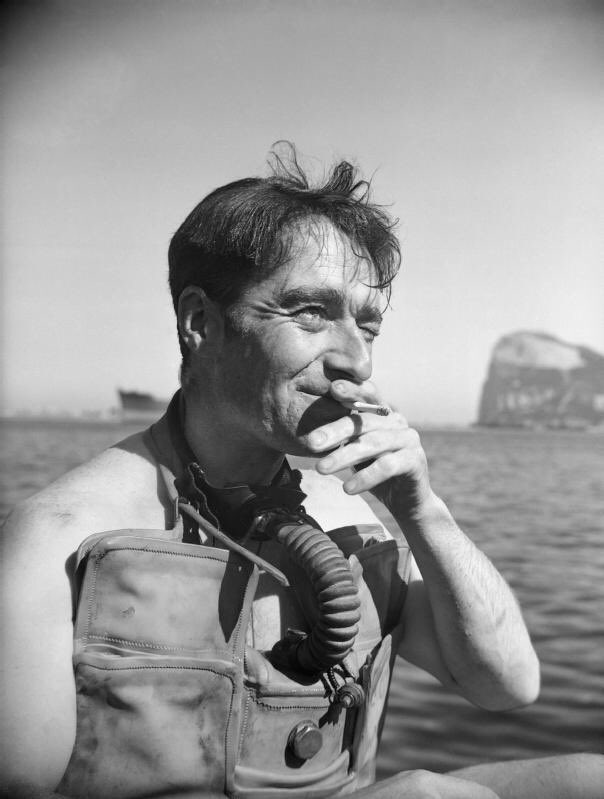
On 19 April 1956 Lieutenant Commander Lionel ‘Buster’ Crabb, OBE GM RNVR disappeared in Portsmouth Harbour and Prime Minister Sir Anthony Eden told MP’s it was not in the public interest to discuss the circumstances and the admiralty stated Crabb had disappeared whilst testing secret underwater equipment some distance from the harbour.
It is widely believed ‘Buster’ Crabb disappeared during a clandestine operation to examine the Soviet Cruiser Ordszhonikidze berthed in Portsmouth Harbour during a visit by Nikita Khrushchev. A headless body with both hands missing and dressed in a diving suit was later found floating in the sea. Even after the forensic pathologist who examined the body stated they were not the remains of Crabb because known scars on the legs were not present the body was reported to have been Lt Cdr Crabb and buried in Milton Cemetery, Portsmouth and researcher Sydney Knowles later claimed Crabb had not dived alone.
Since his disappearance there has been much speculation, many conspiracy theories and the files remain classified until 2057.
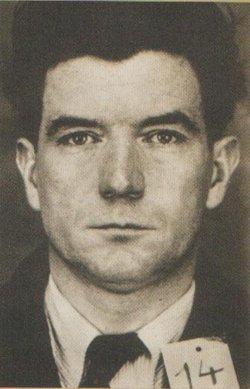
According to records Barrett was born on 23 January 1916 in Paris to British parents and was a tailor before joining the RAF. After being recruited by SOE he completed training and selection on 23 April 1943 and was given the code names Honoré, Innkeeper and Charles Meunier.
It is thought to have been November 1943 (dates vary) when Barrett parachuted into the Aube department in north-east France to work as the wireless operator for a circuit in the Troyes area and seven months later, he was seriously compromised and extracted by Lysander aircraft from 161 Special Duty Squadron RAF. After additional training he returned to France by parachute in early March 1944 and worked as the wireless operator for a new circuit called Minister that was located in the Seine-et-Marne department around 34 miles from Paris.
Pierre Pulsant, the organiser of Minister circuit described Barrett as:
“A grand Officer. The ideal W/T operator. Technically perfect. Security first class. Willing to undergo any hardship for the safety of his mission. Unselfish, courageous, outstandingly efficient. A very honest and reliable man with imagination and guts. One of the best men we ever put in the field.”
Barrett had two wireless sets, one he kept in Troyes the other was hidden in the countryside around 14 miles from the town. After Abwehr wireless intelligence detected signals coming from Troyes the agent was arrested whilst transmitting to London, Barret then stopped using his set in the town and to make it difficult for the Abwehr to pinpoint his location began using his set in the countryside and never transmitted from the same location.
For over a month Barrett cycled the 14 miles to Derry-Saint-Pierre where his set was hidden whilst avoiding German patrols on the main road and sometimes cycled past stationary direction-finding vans listening out for signals, but despite ensuring he took the necessary security precautions he was eventually captured whilst in contact with London.
Typical of the confusion surrounding SOE clandestine operations, historian MRD Foot wrote that Barrett was captured whilst being part of a group that was extracting an SAS party that had got into difficulty in the forest of Fontainebleau, but this was not the case.
After the war Barrett’s name was found on the wall at Gestapo HQ at Avenue Foch in Paris. He was later moved to Frésnes Prison outside Paris and then to Buchenwald Concentration Camp. According to Foot, Barrett was among the first fifteen or thirty-one agents to be hanged at Buchenwald during the first week of September 1944. However, this does not correspond with the details in his personal file and the research conducted by the Commonwealth War Graves: Barret was one of a second group of eleven agents removed from Block 17 at Buchenwald on 4 October 1944 and killed through the course of the night. It was also discovered Barrett was shot.
22-year-old Egon Berliner was born in Austria on 9 May 1923 to a Jewish family and in 1938 was involved in a fight with the Hitler Youth and was chased by the SS for two hours before managing to escape. In 1939 he arrived at his family flat, and the porter warned him two Gestapo officers were waiting for him, Berliner then escaped to England and was recruited by SOE in May 1943.
After passing selection and training Berliner was asked whether he was willing to volunteer for a mission to contact a communist group in Innsbruck, Austria and determine whether they could be developed into a resistance group, though SOE in London considered it unlikely they would risk opposing the Nazi authorities it was decided to send one exploratory agent and on the night of 28-29 July 1944 Berliner was dropped by parachute into southern Tyrol to make his way to Innsbruck. After contacting the communists SOE doubts were correct and Berliner made his way to the allied lines in southern Italy.
He later volunteered to return to Austria and discover whether a Social Democrat Group could be transformed into a resistance movement and after they refused he distance himself from everyone he had contacted and travelled to the Koralpe (Koralm) mountain range in southern Austria and after being denounced by a member of the group was arrested by the Gestapo whilst attempting to cross the River Drave to Yugoslavia in early April 1945.
Berliner was taken to the Gestapo prison in Gratz where he was tortured for two hours and suffered more brutal treatment for being a Jew before being thrown into a condemned cell with two other prisoners. At 20:30hrs on Tuesday 4 April 1945 Gestapo SS -Obersturmführer Herz of the Graz Gestapo entered the cell and read out the names of those to be executed, Berliner and other men were then put into the back of a lorry to be taken to the SS barracks in Wetzelsdorf.
After the war captured Gestapo officers claimed the lorry received a direct hit from an allied aircraft and all the prisoners were killed but a subsequent investigation discovered they were executed by the SS.
23-year-old Philip Amphlett was recruited from No.2 Commando, but his SOE training report said he was unsuitable as a clandestine agent and was better suited for direct action and parachuted into France on 16 August 1943 with a small team as part of Operation Scullion II after a similar operation (Scullion I) had failed. The team was sent to sabotage a distillation plant near Autun, France that was making synthetic oil but after reaching the target their demolition charges caused little damage.
Amphlett was last seen in Dijon on 23 August 1943 whilst making his way to an extraction point to escape from France and nothing more was heard from him. Over a year later it was discovered Amphlett had been captured and after being interrogated by the Gestapo was transported to Flossenburg Concentration Camp where he was executed,
In October 1945 Vera Atkins, SOE French Section intelligence officer who after the war went on a personal crusade to track down missing members of her section, wrote to his father saying ‘his son had shown exemplary courage and an uncompromising attitude towards his jailers’. Philip Amphlett has no known grave.
The capture and execution of Jack Agazarian is complex, surrounded by conspiracy theories; is beyond the scope of this brief essay and is covered in great detail in my forthcoming book.
Jack Agazarian was the second of six children of an Armenian father and French mother and was a British citizen when he joined SOE on 30 May 1942. He arrived in France by parachute on the night of 29 December 1942 and worked as the wireless operator for the Physician circuit operating in Paris. Physician is sometimes wrongly called Prosper: Prosper was the code name of its circuit leader Francis Suttill and to avoid confusion the circuit is sometimes referred to as Physician/Prosper.
During the six months Agazarian was in France he maintained contact with London and arranged weapons and sabotage stores to be dropped by parachute; received orders and arrange the arrival of other agents by parachute and air landings by Lysander aircraft.
Lysander pilots needed a specially trained agent on the ground called an air movements officer who ensured the field was suitable for the technical specification of the aircraft and commanded members of the resistance responsible for laying out signal lamps in a recognised pattern indicating wind direction and where the aircraft needed to land, and the local air movement officer was an agent named Henri Déricourt.
It is known Jack Agazarian and other agents suspected Déricourt of being a double or even a triple agent working for the Gestapo and Abwehr and after Agazarian returned to London he reported his suspicions.
Henri Déricourt. Photograph thought to have been taken during his trial.
Agazarian was on leave when he was asked if he would volunteer to return to France with Nicholas Boddington to investigate his claims and it later transpired Boddington was a pre-war friend of Déricourt and recommended Déricourt to SOE. Agazarian arrived in France on the night of 22 July 1943 and after meeting Boddington there is no explanation why Agazarian volunteered to visit Déricourt’s safe house after saying it was dangerous and after arriving was arrested by the SD.
It is known Jack Agazarian spent time at the SD Paris headquarters at Avenue Foch and Fresnes Prison before being deported to Flossenburg Concentration camp in Bavaria, Germany where he was executed. After the war Déricourt was tried in a French court for treason but was not convicted after Boddington gave evidence for the defence, and after an investigation by MI5 Boddington was cleared of any wrongdoing.
Henri Déricourt returned to his flying career and is thought to have been transporting illegal opium throughout Asia. On 21 November 1962 Déricourt took off from Vientiane, Laos with a load of gold and four passengers and after the aircraft crashed his body was never recovered. In 1986 Colonel Morris Buckmaster, the former commanding officer of SOE French Section, was asked whether Henri Déricourt was a German agent and he replied “Nobody knows. He’s dead and the truth died with him.”
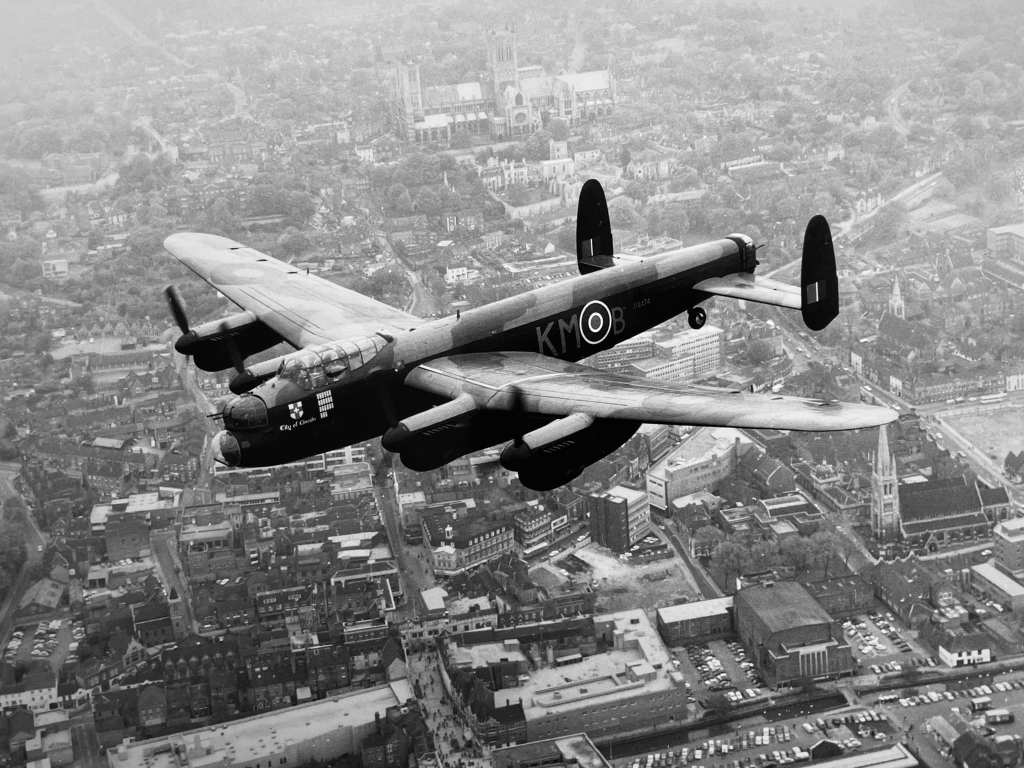
When the Lancaster is seen at air shows many are not aware this aircraft is a flying memorial to the 57,000 aircrew killed during WW2. There was also a further 8,903 wounded due to enemy action and 9,838 POW’s. (no image source but possibly from the Battle of Britain Memorial Flight)
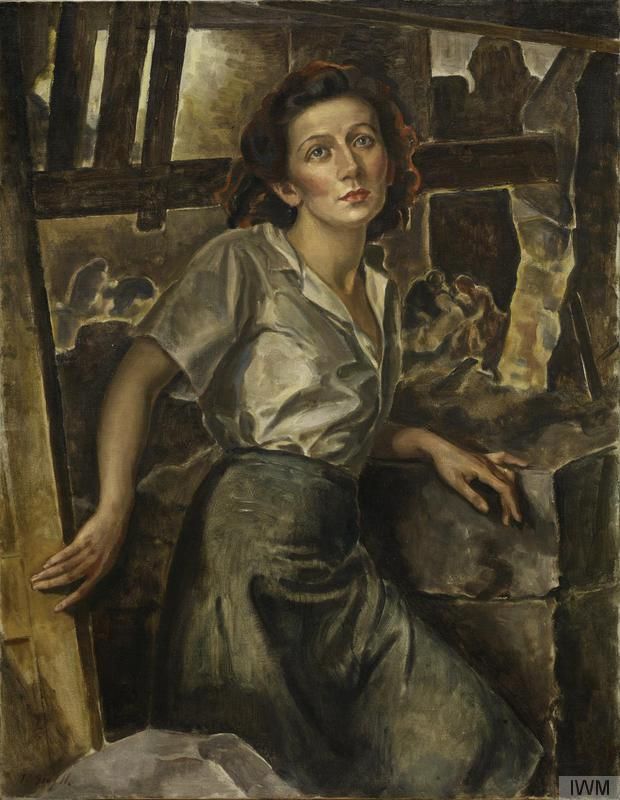
Portrait at the IWM On 7 August 1942 whilst serving as a Scottish fire warden she was part of a team extinguishing a large fire at a burning building after an air raid. She was inside the building when she heard cries for help coming from under a collapsed wall and found a sailor seriously injured. Whilst surrounded by smoke an flames she called for a rope to be lowered and after tying it around the sailors waist he was hoisted to safety. Within less than a minute after Patterson left the building the walls collapsed. On 12 February 1943 Marion Patterson was awarded the GM by King George IV and the king also commissioned this portrait of her which was displayed at the National Gallery. (IWM)
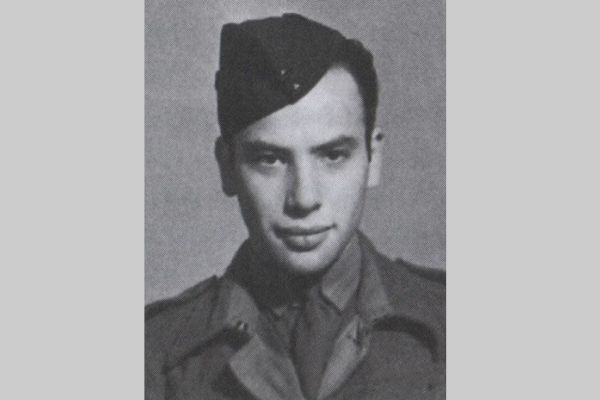
Adler was born in Hungary on 15 September 1919 and was recruited by SOE on 21 September 1942. After infiltrating the Cagliari area of Sardinia, Italy by submarine he was captured soon after reaching the shore. The Italian Military Intelligence Service (Survizio per le Informazioni e la Sicurezza) attempted to playback his wireless to London but the incorrect codes were sent, and London was aware it was an attempted wireless deception.
In May 1943 Adler was transferred to the Regina Coeli Prison in Rome that was taken over by the German SD (Sicherheitsdienst) following the Italian surrender. After being interrogated by the SD he gave away no important information and convinced his interrogators he was a British officer named John Armstrong. After the war it was discovered that a ‘John Armstrong’ was in a prison at Lake Bracciano approximately 35 miles from Rome and after the liberation of Rome by Allied forces in June 1944 an investigation attempted to find out what happened to Gabriel Adler aka John Armstrong.
After extensive enquiries it was discovered that on 3 June 1944 Adler was one of 80 prisoners selected by the SD to be transferred to a prison in northern Italy ahead of the Allied advance. The group of prisoners had been assembled in the courtyard at Regina Prison with their hands tied behind their backs. They were put into the backs of lorries and told they were being taken to the SD headquarters at the Via Tasso in Rome, now the home of the Museum of Liberation, and then onto Florence. At 0:30 hrs on 4 June a second group of prisoners were assembled in a similar manner as the first group and put into the back of lorries.
It was later claimed a few of the prisoners believed they were going to be killed and after leaving the compound attempted to escape and though shots were fired a few managed to get away. Another report states the first batch of prisoners also attempted to escape after their convoy of lorries were attacked by Allied aircraft but there was no mention of Adler. According to a priest at the Santo Spirito Hospital in Rome a large number of bodies arrived, and one was listed as an unknown English Soldier, but Investigators concluded Adler was not among the bodies because he was known to be wearing a battle dress over which was a pair of Skiing trousers and a wind jacket and none of the bodies were wearing such clothing.
When the Allies reached Rome the Regina Coeli Prison was empty and a witness said even after the last German lorry was leaving the remaining prisoners were being released. There is a plethora of confusing and contradicting information and the investigating team concluded Adler was most probably dead and was eventually listed presumed dead with no known grave.
Alfred Wilkinson. Circuit organiser serving with the French Section SOE
Alfred Wilkinson had duel nationality British/French and was born in Paris and left his wife and young child in France to join the British Army.
Wilkinson parachuted into France on 5 April 1944 to organise the Historian circuit in the Orléans area where his wife and young child were still living, and SOE documents described it as “an area where German repressive measures had effectively checked all previous attempts to develop a resistance network. After receiving arms and other war materials by parachute Wilkinson and his Historian circuit prepared for large scale sabotage for D-day and by 6 June (D-day) the railway lines and telecommunication targets his circuit had been ordered to sabotage had been destroyed and added to the major disruption of the German military caused by other circuits.
It is known Wilkinson was captured towards the end of June at Olivet a commune in the Loiret department in north-central France and for the first fortnight was kept at the Eugéne Prison in Orléans. He was then taken to Frésnes Prison outside Paris where he was described by other SOE prisoners as looking well and Wilkinson was among a large batch of SOE agents and resistance fighters taken from Frésnes to Buchenwald concentration camp to be used as slave labour.
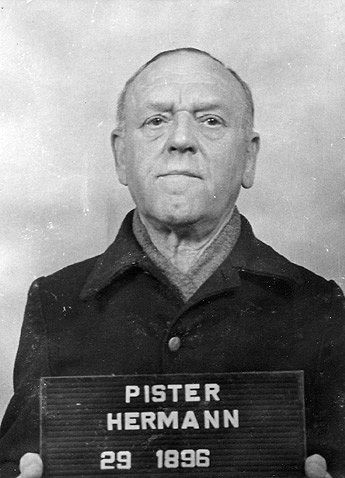
On 24 August Allied aircraft bombed the Gustloff armament factory outside the camp where many prisoners were forced to work. Several bombs hit the SS barracks killing 8 and injuring 300 SS soldiers and many prisoners. It was later said that in retaliation for the air raid the camp commandant Obersturmbannfuhrer Herman Pister ordered the execution of all British and French ‘terrorists.’
Seven prisoners were executed on 14 September and on 5 October more prisoners including Alfred Wilkinson were executed and according to a post-war investigation before being hung the men stood rigidly to attention whilst shouting ‘long live France. Long live England.’
Notorious Hermann Pister. Image taken after being arrested by American forces.
After the war Pister was convicted of war crimes and sentenced to death but died of a heart attack before being hung.
 Alan Malcher