Walter Chibnall was a miner living in Beaufort, Victoria, Australia before enlisting into the Australian Army on 15 March 1916 to fight during the Great War. This photograph of Walter and his son William is thought to have been taken during the last time they saw each other before his father was posted to Europe to fight on the Western Front. Walter was promoted to Corporal on 14 September and posted to the 1st Reinforcement Regiment, 39th Battalion Mortar Battery.
On 12 October 1917 his father, Walter, was killed during the Battle of Passchendaele, Ypres: during an artillery bombardment Walter was taking cover in a shell crater when it took a direct hit from an artillery shell and has no known grave. At the time of his death he was 32-years-old.
During the Second World War his son, William, enlisted into the Australian Army and died in a Japanese prisoner of war camp at Amon on 20 February 1942. He is thought to have been executed and like his father has no known grave and died at the age of 30, 2 years younger than his father when he was killed. (Photos, The AIF Project UNSW Canberra Australia)
Adrian Carton de Wiart fought in the Boer War, World War One, World War Two and during his military service from 1899 to 1947 he survived being shot in the stomach, groin, head, ankle, hip and leg. He also survived two air crashes, five escape attempts from a prisoner of war camp and after a doctor refused to amputate his fingers he bit them off. He also lost an eye and in 1915 was awarded the VC.
Adrian Carton de Wiart was born in Belgium in 1880 to an Irish mother and a Belgium aristocrat but it was widely rumoured he was the illegitimate son of the King of Belgium, Leopold II.
In 1899 he was sent to England to study at Oxford University but quickly dropped out and enlisted into the British Army under a false name and was known as Trooper Carton and was sent to fight in South Africa during the Boer War. He was shot in the stomach and groin and sent back to England but after recovering he rejoined the army under his real name and after being commissioned returned to South Africa in 1901.
During the British campaign against the ‘Mad Mullah’ in Somaliland whilst attacking an enemy fort Carton de Wiart was shot twice in the face and lost his left eye.
For a short time he wore a glass eye but whilst travelling in a taxi he threw it out of the window and put on a black eye patch which he wore for the remainder of his life.
Whilst serving on the Western Front as an infantry commander during the Great War he was wounded seven more times and after a doctor refused to amputate his mangled fingers he bit them off.
During the Battle of the Somme he was shot through the skull and ankle, at the Battle of Passchendaele he was shot through the leg and whilst fighting at Arras he was shot through the ear.
His citation for his VC during the Battle of the Somme States:“For most conspicuous bravery, coolness and determination during service operations of a prolonged nature. It was owing in a great measure to his doubtless courage and inspiring example that a serious reverse was altered. He displayed the utmost energy and courage in forcing an attack home. After three other battalion commanders had become casualties, he controlled their commands, and ensured that the ground won was maintained at all costs. He frequently exposed himself in the organisation of positions and of supplies, passing unflinchingly through fire barrage of the most intense nature. His gallantry was inspiring to all.”
Despite losing various body parts Carton de Wiart said, “Frankly, I enjoyed the war”
From 1919 to 1921 he saw further action in Poland during the Polish-Soviet War and whilst on a train being attacked by the Soviet Cavalry he fought them off with his revolver from the running board of the train and at one point he fell onto the track and quickly jumped back to continue the fight. He later survived an air crash and spent a brief time in captivity.
He retired from the British Army in 1923 with the rank of Major-General (said to be honorary) and spent the next 16 years hunting on a friend’s 500,000 acre estate in Poland a few miles from the Soviet border. At the outbreak of the Second World War in 1939 he was recalled as head of the British Military Mission in Poland and later escaped Poland with his staff whilst being chased by German and Russian soldier and despite being attacked by the Luftwaffe they made it to the Romanian border. Carton de Wiart then travelled back to England by aircraft after obtaining a false passport.
In 1940 he commanded Anglo-French forces in Norway with orders to take the city of Trondheim and with little support managed to move his troops over the mountains during which they were attacked from the air by the Luftwaffe, shelled by German navy destroyers and machine gunned by German troops and was eventually ordered to evacuate and board Royal Navy transports which were heavily attacked during their withdrawal.
On his 60th birthday he arrived at Scapa Flow in the Orkney Islands, Scotland and after returning to his London home it was bombed out during the blitz and all his medals were destroyed and he had to apply to the War Office for replacements.
In 1941 he was appointed head of the British-Yugoslavian Military Mission and whilst on an aircraft flying to Cairo both engines failed and crashed in the Mediterranean off the coast of Libya which was controlled by Italy. After being knocked out during the crash he was revived by the cold water and he along with the crew swum a mile to the shore where they were captured by the Italians and sent to a POW camp in Italy.
Carton de Wiart was involved in five escape attempts, including spending seven months tunnelling with other prisoners. After one escape he spent eight days disguised as an Italian peasant but was easily recognised because he had one eye, one arm and could not speak Italian.
In 1943 he was released from prison and acted as a negotiator for the Italian surrender after which he returned to England and became Churchill’s personal representative in China until 1947. Whilst returning to England he stayed at a guest house and whilst walking down the stairs he slipped on coconut matting and fell, knocked himself out and broke his back. After eventually arriving back at England it has been said a doctor successfully extracted an incredible amount of shrapnel from his old wounds.
During the draft of his autobiography he forgot to add he was awarded a VC and been married to a countess.
Lieutenant-General Sir Adrian Paul Chislain de Wart VC, KBE, CB, CMG,DSO eventually moved to County Cork, Ireland, where he died in 1963 at the age of 83.
After his death one commentator said: “With his black eyepatch and empty sleeve, Carton de Wiart looked like an elegant pirate and became a figure of legend”
On 12 June 1915 at Givenchy-Lés-la Bassée, France, Lance Corporal Angus saw Lieutenant James Martin lying a few yards from German trenches after being injured by a landmine.
After leaving the safety of his trench Agnus run over 209 feet across no-man’s land under heavy rifle fire during which he was hit 40 times and lost an eye but continued towards the injured officer who he dragged back to the British trench whilst still under heavy fire.
After two months in hospital he was awarded the VC by King George V at Buckingham Palace on 30 August. When the king commented on his 40 injuries Agnus replied “Aye sir, but only 13 were serious.
Each year until his death in 1959 William Agnus received a telegram of thanks from the family of the officer he saved.
He is buried along with his wife Mary at Wilton Cemetery in Carluke, Scotland and his VC is displayed at the National Museum of Scotland in Edinburgh Castle.
On 2 May 1892 Manfred Von Richthofen was born in Kleinburg near Breslau which is now part of Warsaw, Poland, and his family were influential members of the Prussian aristocracy.
At the start of World War One in 1914 Von Richthofen was serving as a cavalry officer and in 1915 he decided to transfer to the German Air Force which had been founded in 1910 and already this new branch of the Imperial Germany Army was noted for upholding the honour of Prussian military tradition.
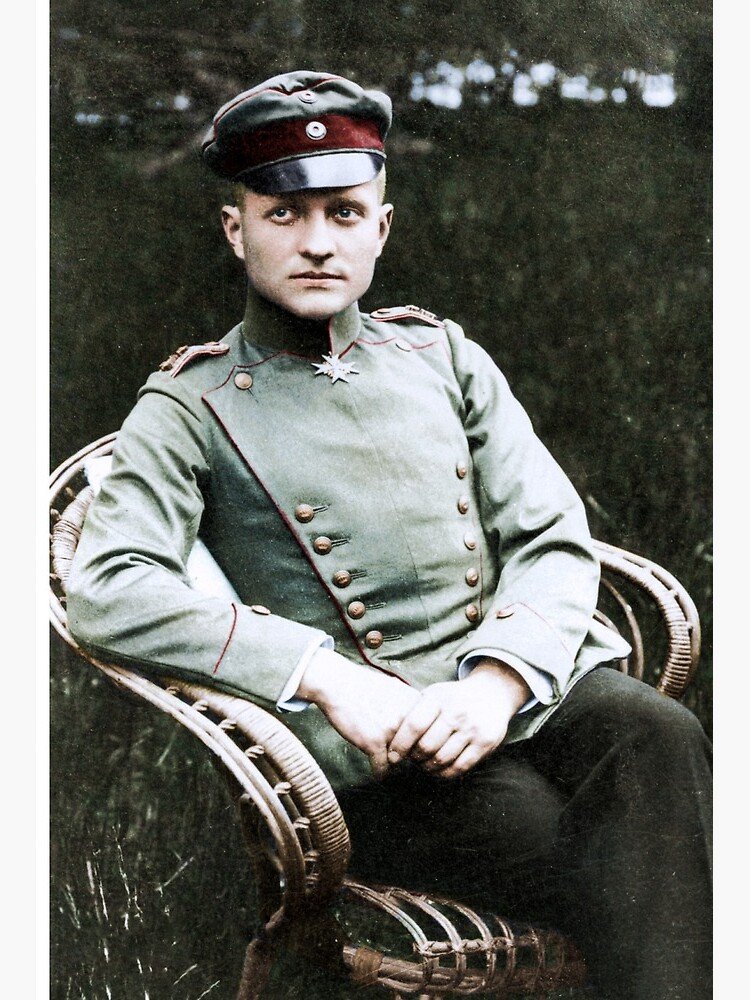
Manfred Von Richthofen wearing the Blue Max which was Prussia’s highest military order
At the age of 23 Richthofen’s mentor was German Fgher Ace Hauptmann Boelcke who was one of the most influential patrol leaders and was described as the ‘Father of Air Fighting Tactics’. Boelcke officially had 40 aerial victories but his student Manfred Von Richthofen later more than doubled this and became a legend throughout Germany and among his enemies whilst Boeleke became widely forgotten as Von Richthofen’s celebrity status as a fighter ace increasingly grew.
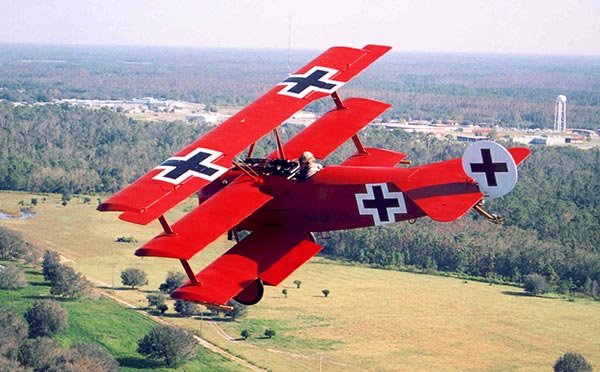
Richthofen was one of the first members of fighter squadron Jagdstaffel 2 in 1916 and in 1917 became the leader of Jasta 11, which later formed the larger fighter wing Jagdgeschwader 1 which became better known as the ‘flying circus’ because all the aircraft were brighly painted and by the way the fighter wing moved throughout allied areas like a travelling circus.
(source unknown)
Manfred Von Richthofen’s red aircraft became famous and his 80 air combat victories earned him the nickname the ‘Red Baron’.
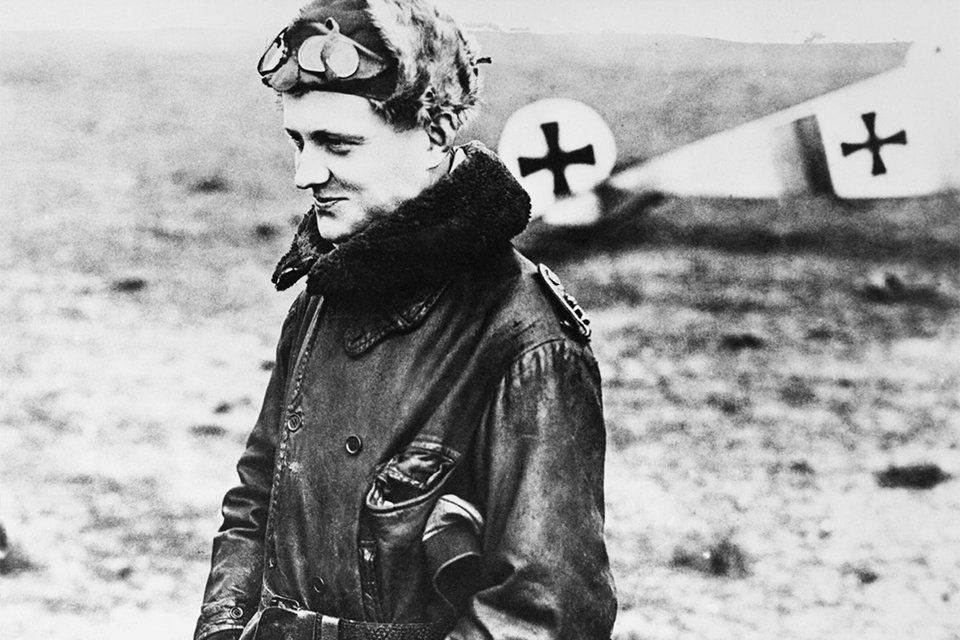
Photograpth taken in 1916 early during his flying duties.
On 23 Novemeber 1916 Richthofen shot down British Fighter Ace Major Lanoe VC during a long dog fight during which Lanoe was eventually shot through the head and Richthofen immediately showed his respect by publicly describing Hawker as the ‘British Boelcke’.
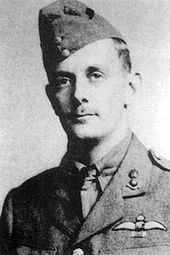
Major Lanoe Hawker VC.
Who Shot Down and Killed The Red Baron?
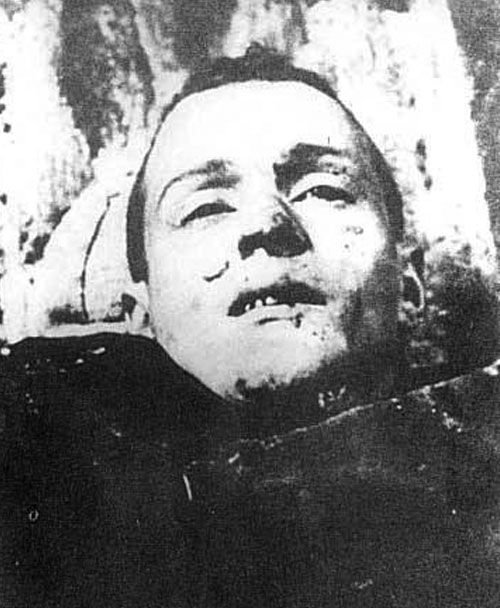
(source unknown)Body of Manfred Von Richthofen (aka The Red Baron)
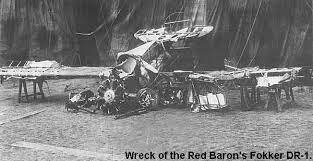
The RAF credited a pilot named Arthur Roy Brown who was a Canadian serving with the Royal Navy Air Service with shooting down the Red Baron but most historians agree this was not the case and Manfred Von Richthofen was killed by machine-gun fire from the ground.
As fighters pilots were taught to attack the rear of enemy aircraft the autopsy report which states the fatal bullet penetrated Richthofen’s right arm pit and exited next to the left nipple, due to the angle supports the ground fire theory.
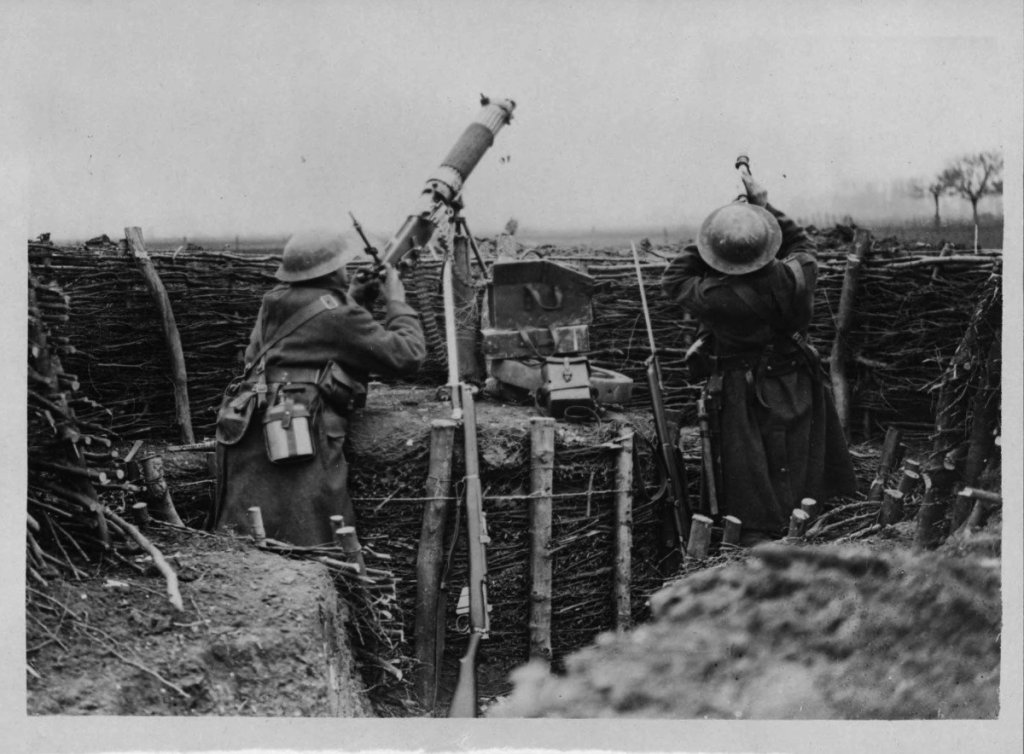
Machine gun being used to fire upon aircraft
It has also been claimed the fatal shot came from a soldier named Cedric Popkin who was an anti-aicraft gunner with the Australian 24th Machine Gun Company who fired at Richthofen on two occastions with a Vickers machine gun: first as he approached his position and then at long range to the right side of the aircraft and this second engagement supports the angle of the fatal bullet.
In 2002 it was suggested Gunner ‘Snowy’ Evans a Lewis machine gunner with the 53rd Battery, 14th Field Brigade, Royal Australian Artillery killed Richthofen, but this claim has been rejected due to the angle. Other sources suggest Gunner Robert Blue also of the 53rd Battery may have fired the fatal shot and although the Sydney council erected a plaque near his former home which states he shot down Manfred Von Richthofen the Red Baron this is also unlikely. The fact is, the person who shot down the Red Baron remains unknown.
Theories: Why did Manfred Von Richofen (Red Baron) fly dangerously close to enemy trenches?
Richthofen was a highly experinced and skilled pilot who followed the lessons from his mentor Boelcke among which was the basic rule of never flying close to enemy trenches and there is no logical explanation why he broke this rule on 21 April 1918 and was shot down.
Some historians suggest he may have been suffering from cumulative combat stress which made him fail to observe basic precautions. I find this theory quite persusasive becuase comparisons may be made with the shooting down by ground fire of British Fighter Ace ‘Mick’ Mannock VC who always warned new pilot to never fly low near German trenches but on 28 July 1918 Mannock broke his own rule and was shot down by a massive volley of ground fire from a German trench. (see further Mick Mannock the Irish Fighter Ace of WW1 an Malcher)
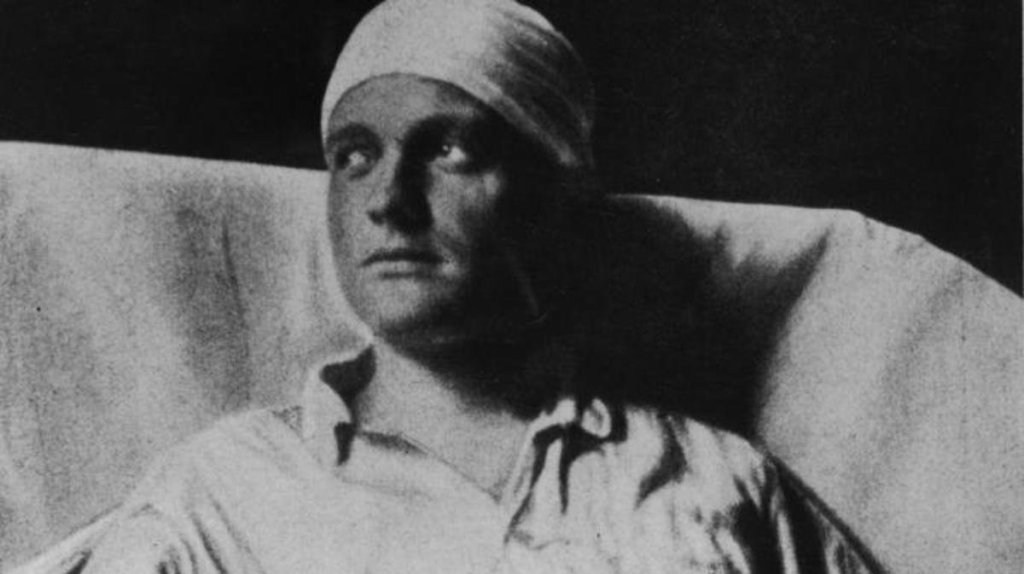
Richthofen in hospital recovering from a gun shot wound to the head. (source unknown)
Other historians suggest Manfred Von Richthofen was not fit to fly after receiving a bullet wound to his head during combat on 6 July 1917 and this theory is supported by unsubstantiated accounts of his personality having changed after being wounded. The fact remains, the person who shot down and killed Manfred Von Richthofen ‘The Red Baron’ and why he broke the basic rule of never flying in range of enemy tranches may never be known.
The German blitz on cities during the Battle of Britain is well documented but the first aerial bombardment of Britain took place 25 years previously and according to some historians was the first ‘modern’ military attack which breeched the traditional boundary between soldiers on the battlefield by targeting civilians.
On the morning of 19 January 1915 two Zeppelins, L3 and L4, took off from their base in Hamburg and headed towards Yorkshire in northern England but due to bad weather over Norfolk L3 turned towards Great Yarmouth and L4 headed towards Kings Lynn.
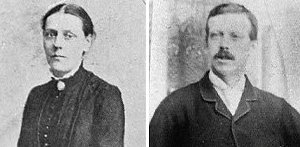
Whilst flying over what newspapers called “the working-class district of St Peters Plain in Great Yarmouth,” L3 dropped its bombs and two civilians were killed: Samuel Smith, a 53-year-old shoemaker, became the first British civilian to be killed during a German air raid and the subsequent enquiry said he was standing on the street when the bombs were dropped. Martha Taylor, 72, was the next to be killed after her home was hit and the area was extensively damaged.
Martha Taylor and Samuel Smith
Meanwhile, whilst L3 was bombing St Peters Plain L4 was dropping incendiary bombs over Sheringham, Brancaster, Dersingham, Grimston before arriving over Kings Lynn at 10.50 pm where it released its bombs.
There was no air raid warning before 26-year-old Alice Gazeley whose husband had been killed three months earlier whilst fighting in France, and Percy Goate aged 14 were killed in their homes.
The mother of Percy Goate later told the inquest, “I saw a bomb drop through the skylight and strike the pillow where Percy was lying… I tried to wake him but he was dead… The house fell in. I don’t remember anymore”
St Peters Plain
13 others were also injured during this raid which was the start of a twelve-month bombing campaign mainly against civilian targets consisting of 52 raids across the country.
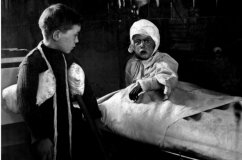
On 13 June 1917 during a daylight raid a bomb hit Upper North Street School in Poplar London. The school building was full of children when a bomb fell through the roof, crashed through the top floor classroom which was being used by girls, then crashed through the second floor which was a boy’s classroom before exploding on the ground floor which was a classroom full of infants.
Eighteen children were killed, sixteen of which were aged between 4 and six and 15 children who could not be identified were later buried in a mass grave at the East End Cemetery, the other three had private graves and national newspapers called the German Air Force the baby killers.
During 1917, 163 civilians were killed and 432 injured
According to official statistics this first strategic bombing campaign caused 5,000 civilian casualties of which1, 413 were killed.
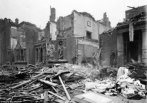
On 7 March 1918, 4 houses were destroyed in Warrington Crescent London W9 during which 12 were killed and 33 injured.
Illustrated with archival film and photographs, as well as interviews with those involved, the documentary traces the evolution of civilian involvement in radio-based intelligence during both world wars. It was the tireless work of amateur radio enthusiasts during World War I, that initially convinced the Admiralty to establish a radio intercept station at Hunstanton. Playing an integral role during the war, technological advances meant that radio operators could pinpoint signals, thus uncovering the movement of German boats, leading to the decisive Battle of Jutland in 1916. Wireless espionage was to play an even more important role during World War II, with the Secret Intelligence Service setting up the Radio Security Service, which was staffed by Voluntary Interceptors, a band of amateur radio enthusiasts scattered across Britain. The information they collected was interpreted by some of the brightest minds in the country, who also had a large hand in deceiving German forces by feeding false intelligence. (BBC 1979)
After war was declared in 1914
Albert Ball enlisted into the army and served with several units including the
Sherwood Foresters and was soon promoted to sergeant and gained his commission
as second lieutenant on 20 October. Ball was eager to see action but was assigned
to training recruits in England so in
the hope of being sent to France he
transferred to the North Midlands
Cyclist Company, but the company remained in England and he expressed his
frustration in a letter to his parents dated 25 February, he wrote, “I have just
sent six boys to France and I hear they will be in the firing line on Monday.
It is just my luck to be unable to go”.
In March 1915 Ball started taking private flying lessons at Hendon Aerodrome and after qualifying for the Royal Aero Club Certificate, on 15 March 1915 he transferred to the Royal Flying Corp (RFC) and trained at Mousehold Heath Aerodrome near Norwich. He completed his training at the Central Flying School Upavon and was awarded his wings on 22 January 1916 and a week later was officially transferred from the North Midland Cycle Company to the RFC as a pilot.
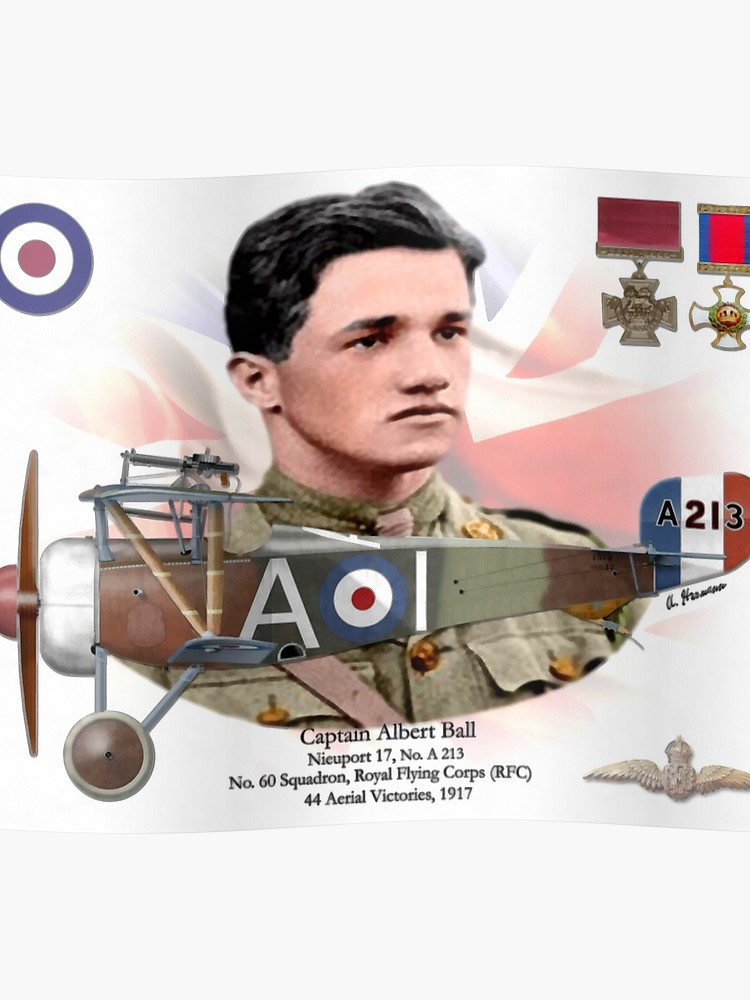
At the age of 20 Captain Albert Ball became the first
celebrity fighter pilot after shooting down 44
enemy aircraft in just one year. He was also the first man during the
war to be awarded three DSO’s.
After his first dog fight Ball wrote in one of his letters
to his parents:
“I like this job, but nerves do not last long and you
soon want a rest…” and in a later letter to his father he discouraged the
idea of his youngest brother following him into the RFC.
Albert Ball was described as a ‘lone wolf’ because he mostly flew solo missions and stalked enemy aircraft from below and used an adapted Lewis machine gun to fire upwards into the enemy’s fuselage.
Gun adapted to fire upwards
Although he quickly became a fighter ace and enjoyed aerial combat Ball had no hatred
for the enemy and in a letter to his parents he explained, “I only scrap
because it is my duty … nothing makes me feel more rotten than to see them go
down, but you see it is either them or me, so I must do my duty….”
On his 20th birthday Ball was promoted to
temporary Captain.
In another letter to his father Ball wrote, “I get tired of always living to kill and beginning to feel like a murderer… I shall be so glad when I have finished.”
The last fight of Captain Ball, VC, DSO and 2 bars, MC, 7May 1917 by Norman Arnold 1919
On the evening of 7 May 1917 near Douai, 11 aircraft of No. 56 Squadron RFC led by Albert Ball encountered German fighters from Jasta 11 (Red Baron’s flight). A violent dogfight in deteriorating visibility resulted in all the aircraft being scattered. Cecil Arthur Lewis who took part in the battle described the mass dog fight in his memoir ‘Sagittarius Rising.’
Lewis recalled Ball pursuing a red Albatros D.111 belonging
to the ‘Red Barons’ younger brother Lothar von Richthofen who eventually landed
near Annoeullin with a punctured fuel tank and Lewis said he last saw Ball flying
into a dark thundercloud before disappearing.
In keeping with the propaganda of the period British newspapers claimed after being shot down 20-year-old Albert Ball died in the arms of a French girl who had pulled him from the wreckage of his machine and only after the war did several eyewitnesses described what really happened when Ball crashed behind the German lines.
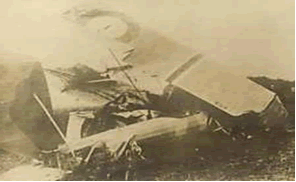
The wreck of Ball’s aircraft photograph taken by German soldier
A German pilot on the
ground, Lieutenant Hailer saw Ball’s plane falling upside down with a dead
propeller from the bottom of a dark cloud at an altitude of 2000 feet.
Brothers Franz and Carl Hailer and two other men in their
party were from a German reconnaissance unit and Franz later noted, “it was
leaving a cloud of black smoke… caused by oil leaking into the cylinders… The engine had to be inverted for this to happen…
The Hispano engine was known to flood its inlet manifold with fuel when upside
down and then stop running…”
Franz Hailer and his three companions ran to the crash site
and Ball was already dead when they arrived. The three German soldiers said the
crashed aircraft had suffered no battle damage and no bullet wounds were found
on Ball’s body and a German doctor at a field hospital later said Albert Ball died
from a broken neck and a crushed chest. His limbs were also fractured, and his
injuries suggest he was killed due to impact with the ground.
Based on these eyewitness accounts It is now considered probable
Ball was not shot down but had become disorientated and lost control. This has been described as temporary vertigo
which had claimed other pilots. A month
after Ball crashed the Germans dropped a message over the British lines
announcing he was dead and had been buried in Annoeullin with full military
honours.
In 1918 Walter Briscioe and H Russell Stannard published a seminal biography, Captain Ball VC and reprinted many of his letters. They quote Ball’s most notable opponent Manfred von Richthofen (the Red Baron) saying “he considered Ball by far the best English flying man.” The authors also quote an unidentified RFC pilot who fought with Ball during his last battle as saying, “I see they have given him a VC . Of course, he won it a dozen times over; the whole squadron know that.
After the war
After the war British authorities discovered Ball’s grave which had been behind the German lines and the Imperial War Graves Commission (now called the Commonwealth War Graves Commission) moved 23 British bodies from graves in the location where Ball was buried to Cabaret Rough British Cemetery, but at his father’s request Ball’s grave was allowed to remain and Ball is the only British grave from WW1 the rest are German soldiers. Ball’s father also bought the French field where his son died and erected a memorial on the crash site.
Award citation Victoria Cross
Lt (temp Captain)
Albert Ball, DSO, MC, late Notts and Derby. R. and RFC
For most
conspicuous and consistent bravery from 25 of April to the 6th May
1917, during which period Capt. Ball took part in twenty-six combats in the air
and destroyed eleven hostile aeroplanes, drove down two out of control and
forced seven others to land.
In these combats
Capt. Ball, flying alone, on one occasion fought six hostile machines, twice he
fought five and once four. When leading two other British aeroplanes he
attacked an enemy formation of eight. On each of these occasions he brought
down at least one enemy.
Several times his
aeroplane was badly damaged, once so seriously that but for the most delicate
handling his machine would have collapsed, as nearly all the control wires had
been shot away. On returning with a damaged machine he had always to be
restrained from immediately going out on another.
In all Capt. Ball
has destroyed forty-three German aeroplanes and one balloon and has always
displayed most excellent courage, determination and skill.
Distinguished
Service Order (DSO)
For conspicuous
gallantry and skill. Observing seven enemy machines flying in formation, he
immediately attacked one of them and shot it down at 15 yards range. The
remaining machines retired. Immediately afterwards, seeing five more hostile
machines, he attacked one at about ten yards range and shot it down, flames
coming out of the fuselage. He then attacked another of the machines which had
been firing at him and shot it down into a village, where it landed on the top
of a house. He then went to the nearest aerodrome for more ammunition and
returned to attack three more machines, causing them to dive under control.
Being then short of petrol he came home. His own machine was badly shot about
in these fights.
Distinguished
Service Order (DSO)Bar
For conspicuous
skill and gallantry. When on escort duty to a bombing raid he saw four enemy
machines in formation. He dived on them and broke up their formation and then
shot down the nearest one, which fell on its nose. He came down to about 500
feet to make certain it was wrecked. On another occasion, observing twelve
enemy machines in formation, he dived in among them, and fired a drum into the
nearest machine which went down out of control. Several more hostile machines
then approached, and he fired three more drums at them, driving down another
out of control. He then returned, crossing the lines at a low altitude, with
his machine very much damaged.
Distinguished
Service Order (DSO) Bar
For conspicuous
gallantry in action. He attacked three hostile machines and brought one down,
displaying great courage and skill. He has brought down eight hostile machines
in a short period and has forced many others to land.
Military Cross
(MC)
For conspicuous skill and gallantry on many occasions, notably when, after failing to destroy an enemy kite balloon with bombs, he returned for a fresh supply, went back and brought it down in flames. He also completed great execution among enemy aeroplanes. On one occasion he attacked six in one flight, forced down two and drove the others off. This occurred several miles over the enemy’s lines.
George Peachment was the son of a barber and lived with his parents in Bury Lancashire. He
wanted to join the army and fight in the
war but was aware the minimum age for overseas service was 19 so decided to lie about his age. According to figures
compiled by the British Legion George Peachment was one of 250,000 young men
under the age of 19 who served in the Great War after claiming to be over 19
years of age.
On 19 April 1915, at the age of 17, he told the recruiting
sergeant he was 19 years old and one
month and wore his father’s bowler hat to make him look older and successfully
enlisted into the Rifle Corp, but his military service got off to a bad start.
Private Peachment was charged for being absent without leave
from 0700 hrs on 2 July 1915 until 0810 hrs 5 July and was fined seven days
loss of pay. Two months later he was confined to barracks for three days for
having a dirty bayonet whilst on parade. Six days later he was fighting during
the opening Battle of Loos, the largest British offensive on the western front
during 1915.
After four-days of artillery bombardments against German
lines at 0630 hrs on 25 September 1915 George Peachment took part in this major
offensive but the preliminary artillery bombardment had not silenced the German
machine guns, barbed wire defences were still intact and once in no man’s land
many British soldiers were cut down by machine gun and rifle fire from the
German trenches creating a scene of mass slaughter common throughout the Great
War.
Due to the large number of dead and dying caught up in
barbed wire defences and scattered across the battlefield, the line was retiring so it could be
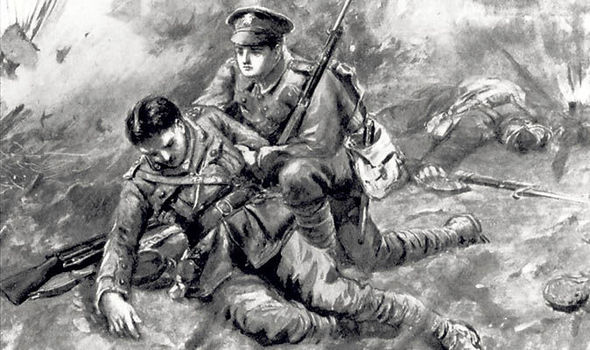
reorganised when private George Peachment saw his company commander, Captain
Dubs lying wounded near the German trenches. Instead of falling back or taking
cover with other men in a shell hole, Peachment whilst under intense machine
gun fire crawled towards Captain Dubs.
In 1996 Lord Ashcroft bought Peachment’s Victoria Cross at auction along with a remarkable letter from Peachment’s company commander to his mother which tells the story of how her son died saving his life. Captain Dubs wrote:
“I cannot tell you how sorry I am that your brave son was
killed, but I hope it may be some consolation to you to know how bravely he
behaved and how he met his end…
When we reached the {barbed} wire we found it absolutely
untouched by our artillery fire and an almost impossible obstacle as a result.
However, we had to push on and I gave the order to try and get through it and
over it. Your son followed me over the wire and advanced with me about 20 yards
through it till we were only about 15 yards from the German trenches. None of
the other men of the line were able to get as far and he was the only man with
me. As a matter of fact, I had not noticed your son with me, but at this point
a bomb hit me in the eye blowing it and part of my face away.
I fell to the ground, but on sitting up found your son
kneeling beside me. The German fire at this time was very intense but your son
was perfectly cool. He asked me for my field dressing and started bandaging my
head quite oblivious to the fire. His first thought was to help me, and
although there was a shell hole nearby where he might have got cover, he never
thought of doing so.
Of course, the Germans were bound to see us sitting up,
and one of them threw a bomb which hit your son in the chest whilst at the same
time I received a bullet in the chest. Your son was beyond feeling any pain
though still alive. I tried to drag him into the shell hole and at the same
time keep him from moving, but at that moment a bullet hit him in the head and
killed him.
After his first wound he was bound to die, in fact he was
already, immediately after he received it unconscious of any pain. I lay beside
him there all day, and eventually we were picked up in the late afternoon when
the trench was taken by a flank attack.
I can’t tell you how much I admired your son’s bravery
and pluck. He lost his life in trying to help me and no man could have been
braver than he was… I have recommended him for the Victoria Cross and have
heard the commanding officer has seen the recommendation.
If he gets it, it is sad to think he is not in this world to receive all the congratulations he would get, but perhaps it may be of comfort to you… Your son died the finest death that man can die, he showed the greatest gallantry a man could show, and I hope these facts help you in your sad loss together with the fact he was spared all pain and suffering.”
IWW
Official Citation
published in the London Gazette 18 November 1915
“During heavy fighting when our
front line was compelled to retire to reorganise, Private Peachment, seeing his
company commander Captain Dubs lying wounded crawled to assist him. The enemy
fire was intense but though there was a shell hole quite close in which men had
taken cover, Private Peachment never thought of saving himself.
He knelt in the open by his
officer and tried to help him but while doing this he was first wounded by a
bomb and a minute later mortally wounded by a rifle bullet.
He was one of the youngest men in his battalion and gave this splendid example of courage and sacrifice. “
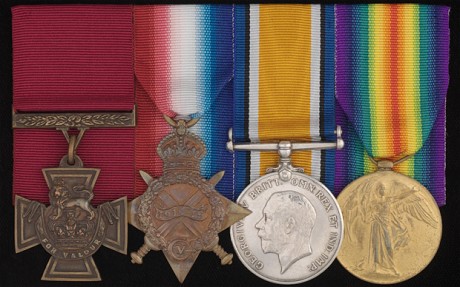
Pte Peachment’s medals (Ashcroft Collection)
On 29 November 1916 the Victoria Cross
was awarded to his mother by King George V at Buckingham Palace. His body was
never recovered but he is commemorated on the Loos memorial which lists the
names of more than 20,000 British and Commonwealth soldiers who died during the
battle.
Third Supplement to The London Gazette of 16 November 1915.
18 November 1915, Numb. 29371, p. 11450
Name: George Stanley PEACHMENT
D.O.B: 5th May, 1897
D.O.A: 25th September, 1915
D.O.D: 25th September, 1915
Award: Victoria Cross
Occupation at time of action: Private, 2nd Battalion The
King’s Royal Rifle Corps, 2nd Brigade, 1st Division






 Alan Malcher