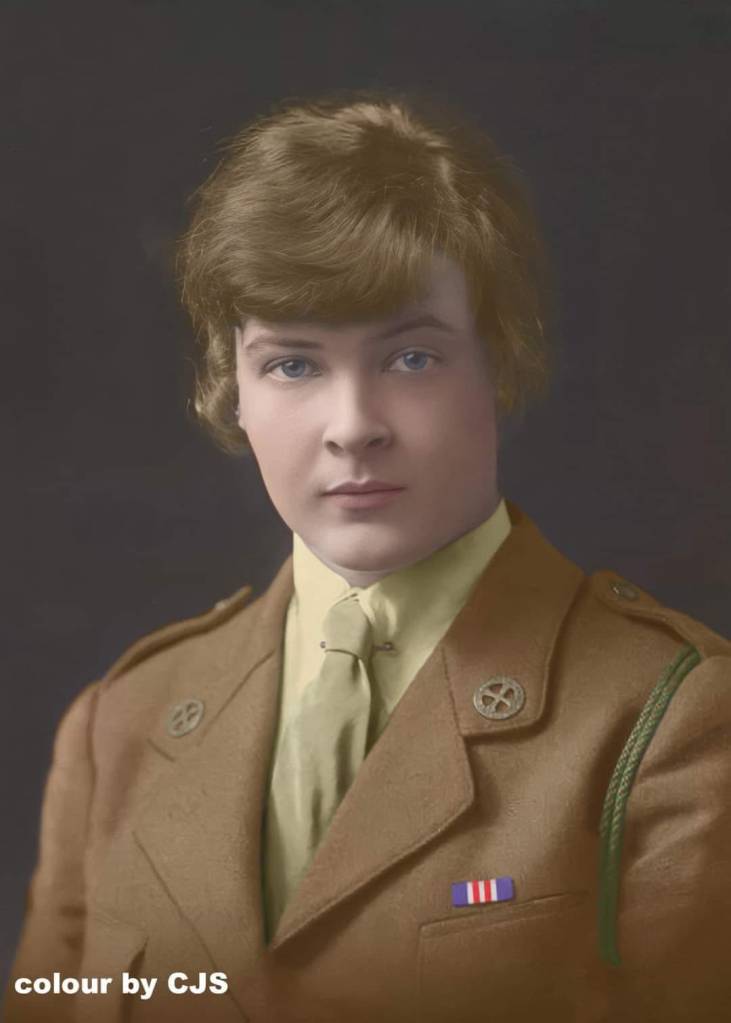
Mary O’Connell Bianconi MM (Research by the Combined Irish Regiments Associations)

Mary O’Connell Biaconi MM (Combined Irish Regiments Associations)

Mary was born into a prominent family in County Clare, Ireland in 1896.
Known to family and friends as “Molly” she attended a convent school in Limerick followed by finishing schools in Paris and Belgium.
When war came like thousands of other women she wanted to play her part and in 1915 joined the Voluntary Aid Detachment (VAD), formed to provide nursing and medical care to the military.
An important role undertaken by the VAD was driving Ambulances carrying the wounded from dressing stations close to the front back to Hospitals near the coast. Such work regularly put the drivers in harm’s way being within range of enemy artillery.
At the age of 21, having completed her medical training and been taught how to drive and maintain an ambulance Molly arrived in France in August 1917.
The historian Lyn MacDonald described girls like Molly thus
“She’s called Elsie or Gladys or Dorothy, her ankles are swollen, her feet are aching, her hands reddened and rough. She has little money, no vote, and has almost forgotten what it feels like to be really warm. She sleeps in a tent. She is twenty-three. She is the daughter of a clergyman, a lawyer, or a prosperous businessman, and has been privately educated and groomed to be a lady. She wears the unbecoming uniform of a VAD. She is on active service and as much a part of the war as Tommy”.
Molly soon transferred to the First Aid Nursing Yeomanry but continued to drive ambulances.
It was during the German offensives in the spring of 1918 that Molly and her fellow drivers faced the greatest danger as they continually ventured close to the advancing enemy to evacuate the wounded.
On the night of 18-19May 1918 heavy German bombing raids in the St Omer area caused extensive damage and many casualties. Rather than taking shelter, Molly and her comrades busied themselves rescuing and evacuating the wounded while bombs continued to fall.
For her actions that night Molly was awarded the Military Medal (MM).
“She worked for long hours under fire in the brave attempt to save the lives of those who had been buried in caves, dugouts and hospitals that had been hit.”
According to a document in the National Archives during the First World War the extraordinary women of the First Aid Nursing Yeomanry were awarded 135 decorations including 18 Military Medals; 32 French Croix de Guerre; one Legion d’Honneur, and 11 Mentions in Despatches.
Molly survived the war and returned to Civilian life. She married in December 1919 and set up and ran a Hotel with her husband.
At the start of the Second World War she once again joined the First Aid Nursing Yeomanry and later became a Junior Commander in the Auxiliary Territorial Service for the duration of the war.
Molly died in Guildford, Surrey in 1968 aged 72.

Above written by The Combined Irish Regiments Association.
Irish Soldiers: the Battle of Mons during the Great War of 1914 to 1918.

The Battle of Mons was the first major action of the British Expeditionary Force of the First World War. It was a subsidiary action of the Battle of the Frontiers, during which the allies fought the Germans on the French border.

I don’t know the source of this short film documentary and consequently I am unable to credit the film maker.

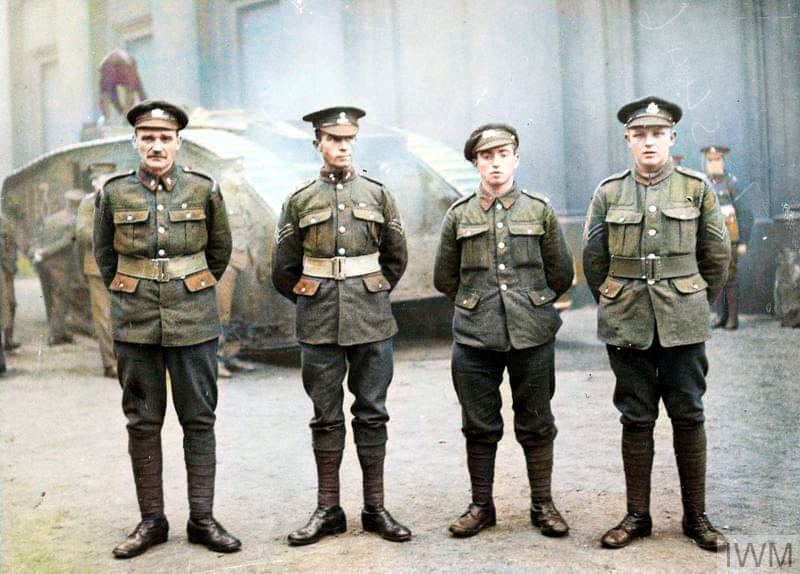
Four recipients of the Victoria Cross during the Great War. IWM image dated 1917.

From left to right:

Private Michael O’Rourke VC, MM 7th (1st British Columbia) Battalion Canadian Expeditionary Force, awarded the VC in France on 15/17 April 1917.

Sergeant James Ockendon VC,MM of the 1st Battalion Royal Dublin Fusiliers, awarded the VC in Belgium on 4 October 1917.

Private William Boynton Butler VC, 17th Battalion West Yorkshire Regiment, awarded the VC in France on 6 August 1917.

Corporal Ernest Alfred Egerton VC, 16th Battalion Sherwood Foresters, Awarded the VC in Belgium on 20 September 1917.

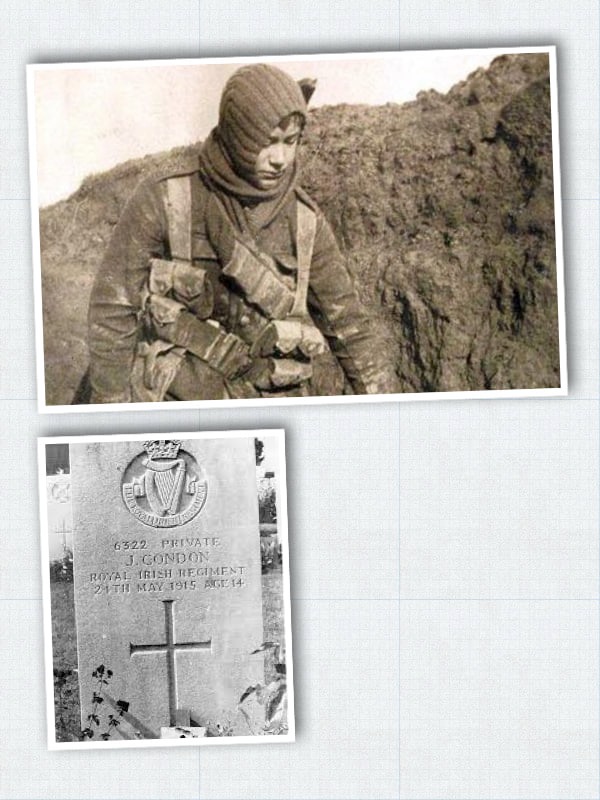
Private John Condon 2nd Battalion Royal Irish Regiment during WW1

6322 Private John Condon of the 2nd Battalion Royal Irish Regiment was killed in action at the age of 14 on 24 May 1915 and is believed to be the youngest battle casualty of the Great War. He is buried at the British war grave at Poelcapelle, Belgium

Alan Malcher

Two Minutes’ Silence by Charles Spencelayh 1928.

Two Minutes’ Silence by Charles Spencelayh 1928.
The clock marks the eleventh hour as the elderly gentleman prays for the son lost in the war, whose portrait hangs above the clock and a jar of garden flowers that have been arranged in his memory. Spencelayh was staunchly patriotic and deeply affected by the war. (Charles Spencelayh 1865-1958)

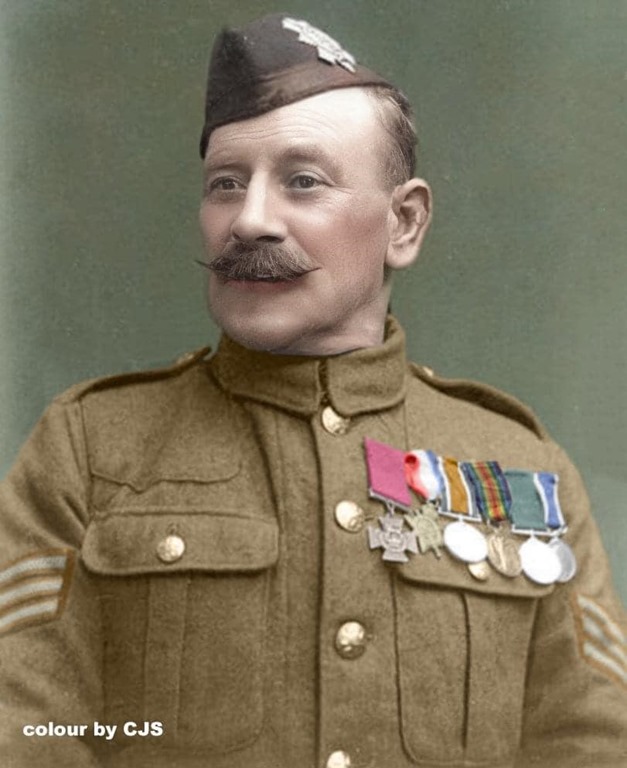
John Ripley VC, Black Watch during WW1.

Corporal Ripley was the first man to climb an enemy barricade before leading his section under fire through enemy barbed wire (entanglements) and held the position until all his men were either dead or wounded during which he was badly wounded in the head and at the age of 47 is listed as the oldest recipient of the VC during the Great War. After being classified unfit for active service Ripley became a recruiting sergeant in Edinburgh. He was discharged in 1919 and returned to his trade as a slater. In 1933 he was fixing slates when he fell from a ladder and injured his spine and later died in hospital.

John Ripley VC

Alan Malcher

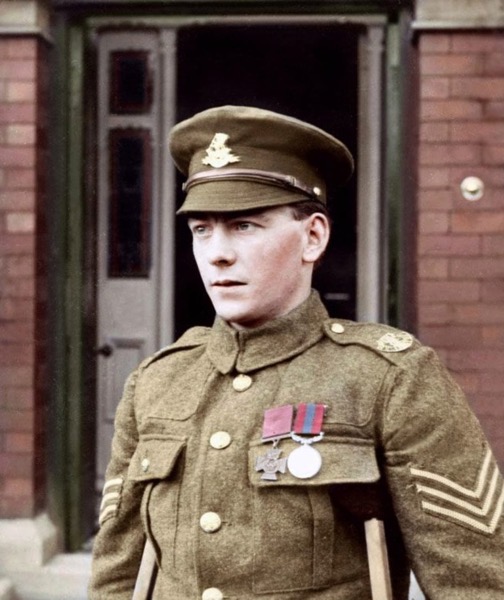
Sergeant Arnold Loosemore DCM, VC. Duke of Wellington’s (West Riding) Regiment 1917

Arnold Loosemore enlisted into the army on 2 January 1915 at the age of 18 and after completing training was posted as a private soldier to the York and Lancaster Regiment and served during the Gallipoli Campaign.

After returning to England he underwent training as a Lewis Machine Gunner and in July 1916 was posted to the 8th Battalion Duke of Wellington’s (West Riding) Regiment and at the age of 21 his battalion was posted to the Somme in France.

Arnold Loosemore VC

On 11 August 1917 his platoon came under intense rifle and machine gun fire from German trenches and were pinned down when Private Loosemore decided to attack the enemy trench alone. After crawling towards enemy barbed wire under fire he found a section which was partly cut and after crawling through with his Lewis gun he continued crawling to higher ground before engaging a German trench and killing around twenty enemy soldiers.

After his Lewis Gun jammed three German soldiers rushed his position which he killed at close range with his revolver before clearing his jammed gun and continuing his lone firefight. Later that day he also killed several German snipers and carried an injured British soldier to safety. For his bravery he was promoted to Corporal then to Sergeant and was awarded the VC.

At Zillebeke in Belgium, on 19 June 1918 his officer was seriously wounded, and his platoon became widely scattered during an enemy bombardment. Whilst disregarding his own safety under machine gun fire Sergeant Loosemore organised his platoon and brought them back along with the wounded to the British lines. It was later recognised it was his leadership which resulted in his platoon later capturing the enemy position and was awarded the DCM (Distinguihed Conduct Medal).

On 13 October 1918 Sergeant Arnold Loosemore DCM, VC was shot in the leg by machine gun fire near Villiers-en-Cauchies, France and his leg had to be amputated above the knee after which he returned to England and was discharged from the army. Due to various health problems associated with his war injury he was unable to find work and died from tuberculosis on 10 April 1924.

His wife Mary who had a young son also called Arnold was refused a War Pension from the government because her husband died after the war and found herself destitute. With no money to pay for a funeral Mary was forced to bury her husband in an existing grave with three other bodies whose families could not pay the funeral costs at All Saints Churchyard, Ecclesall, Sheffield.

John ‘Barney’ Hines also known as the ‘Souvenir King’ during WW1

Photograph of John Hines surrounded by some of his stolen and liberated souvenirs whilst serving on the Western Front.

John Hines was a British-born Australian soldier who served on the Western Front during the Great War who became known for looting whatever he could get his hands on but was also noted for being an aggressive soldier. In June 1917 he captured 60 German soldiers during the Battle of Messines after throwing hand grenades into their pillbox.

Although he was brave in battle his behaviour was erratic and when away from the front line he was court martialled on nine occasions for drunkenness, impeding military police, forging entries in his pay book and being absent without leave. It is also thought he was caught robbing the safe at a bank in Amiens and because of these convictions he lost several promotions he gained for acts of bravery.

In mid-1918 he was discharged from the Australian Army for being unfit due to haemorrhoid problems and arrived back in Australia on 19 October 1918. For the next 40 years he lived near Mount Druitt in a small shelter made of old clothes which was surrounded by a fence on which he hung German helmets and the local people were afraid of him. Despite being a recluse and pennyless he travelled to Concord Repatriation Hospital each week to donate a suitcase of vegetables from his garden to veterans being treated there.

At the start of the Second World War he attempted to enlist but was rejected, at that time he was 60 years old. After being rejected it was widely claimed he attempted to stow away on a troop ship but was caught before the ship sailed.

John ‘Barney’ Hines died at Concord Repatriation HospitaL on 28 January 1958 and buried in a grave which was unmarked until 1971, when a charity paid for a headstone. The council renamed the street on which he lived to John Hines Avenue and a monument commemorating him was built at Mount Druitt Waterholes Remembrance Gardens in 2020.

Historian Peter Stanley said Hines was a man whose skills in fighting were needed and whose knack of souveniring was admired, but he had few gifts that a peaceful society valued.