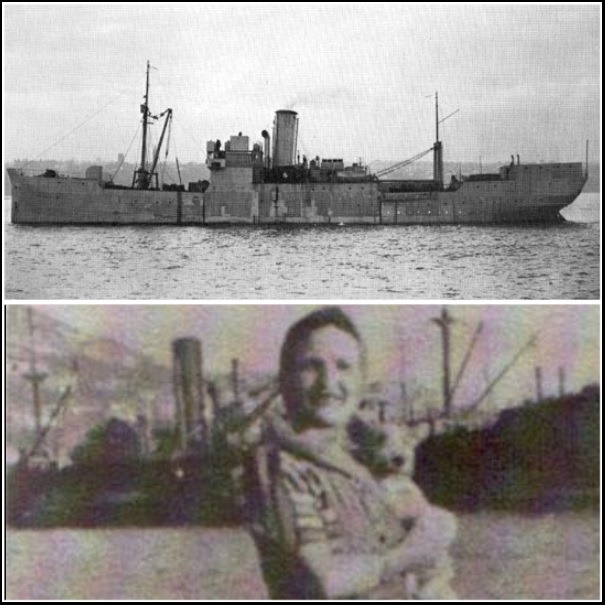
HMS Fidelity (D57) was formerly the French merchant ship La Rhin. In 1941 Fidelity was used by SOE (Special Operations Executive) to transport agents and equipment to southern France and during these clandestine missions flew the flags of neutral Spain and Portugal.
Madeline Baynard was the ship’s first officer but to protect her identity she served with the WRNS under the name of Madeline Barclay.
In late 1941 HMS Fidelity was refitted to serve as a commando carrier and on 30 December 1942 was sunk by a German U-boat. Although most survived the attack the U-boat captain followed the Loconia order which forbid allied survivors being rescued and 369 died in the water: 273 members of her crew (including Baynard), 52 Marines serving with T Coy 40 Commando and 44 seamen who had been rescued after their ship had been sunk during a previous engagement.
On 2 March 1944 Denise Bloch infiltrated central France by parachute and worked as the wireless operator for both Clergyman and Detective circuits which were part of SOE’s clandestine network and began arranging for weapons, sabotage stores, finance and other agents to be sent from London and worked with several reception committees receiving incoming air drops.
It was around 8.20 am on 18 June when her wireless transmissions were located by German direction finders and her Safehouse raided by the Sicherheitsdienst des Reichsführers-SS (Security Service of the Reichsführers-SS), or SD, and Bloch along with another agent were captured.
It is known Bloch was tortured for information, but her wireless was not used by the Germans, and it appears Bloch refused to give the SD her personal wireless codes used to confirm her identity to London. It is also known she was transported to prisons in Germany during which she suffered from exposure due to the cold and malnutrition and was eventually transported to Ravensbrûck Concentration camp where she was executed on 5 February 1945 at the age of 29 and like many agents has no known grave after her body was cremated along with many others.
This plaque will be found outside 64 Baker Street London W1. This plaque marks the former HQ of SOE (CD). Most of the office space in Baker Street accommodated SOE Country Section HQ’s which have no plaques and their wartime use has mainly been forgotten. 83 Baker Street, for example, was the HQ of the French Section.
Left: Leo Marks (24 September 1920 to 15 January 2001) the head of SOE’s codes and cyphers based at Michael House Baker Street, London. Right: his adversary in the Netherlands Abwehr (German Military Intelligence) Lieutenant Colonel Herman Giskes who was responsible for the wireless deception resulting in many SOE agents from the Dutch Section and members of the resistance being captured and executed. People who knew Marks said his brain was wired differently and could workout complex problems and it was Marks who discovered the Abwehr wireless deception alternatively called the ‘wireless game’ and ‘Englandspiel’ (England Game). (Photos IWM)
Hugo Bleicher was a sergeant with the Abwehr stationed in France. Despite his rank Bleicher was responsible for crushing resistance throughout France and due to his ruthless approach and high success rate was supported by senior officers in the Abwehr. SOE agents and members of the resistance who were tracked down and arrested by Bleicher were handed to the Gestapo and were tortured for information, eventually executed or sent to concentration camps.
Bleicher used the cover names Colonel Henri, Jean Verbeck and Jean Castel. After the war Bleicher insisted he was not aware the prisoners he handed to the Gestapo would be tortured and executed but Colonel Maurice Buckmaster who was the Commanding Officer of SOE’s French Section rejected this claim and accused him of being an arrogant upstart and a war criminal. Hugo Bleicher also gave evidence against former members of the Abwehr and until his death in 1982 Bleicher ran a tobacconist in Tettnang, Germany. (Photo IWM)
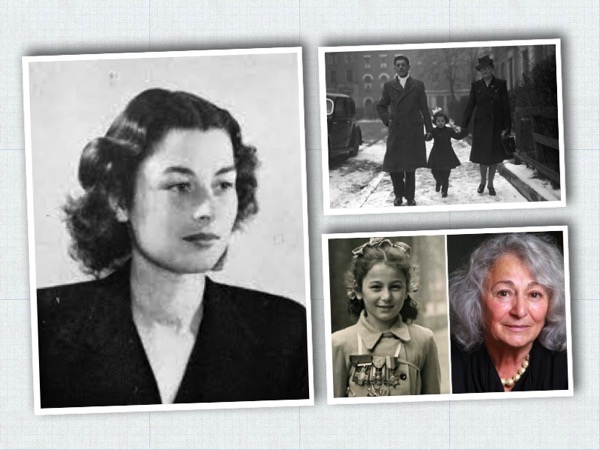
During her second mission to France Violette Szabo was captured after a fire fight with troops from 2nd SS Panzer Division Das Reich after being stopped at a roadblock outside Salon-la-Tour during which she expended eight magazines from her Sten submachine gun. Due to confusion the story of her firefight has been revised several times. According to the citation for the GC she was surrounded in a house and fired from windows during which she killed and injured several German soldiers.
After her capture she was interrogated at Gestapo (SD) headquarters at Avenue Foch in Paris and later transported to Ravensbrûck concentration camp. On 5 February 1945, at the age of 23, Violette Szabo, who had been sentenced to death, was shot through the back of the neck.
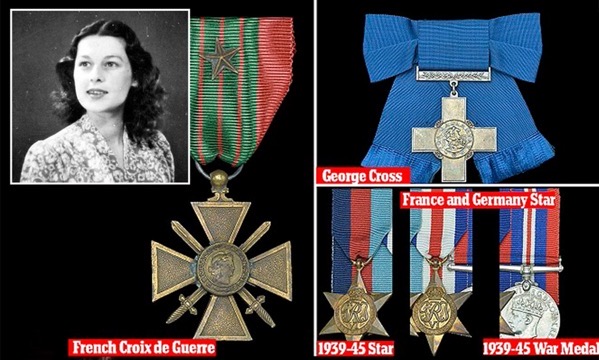
In 1946 her daughter Tanya was taken to Buckingham Palace by her grandparents to receive her mother’s posthumous GC (George Cross) from the King.
Citation for the GC
St. James Palace, SW1. 17 December 1946
The King has graciously pleased to award the George Cross to:-
Violette, Madame SZABO (deceased), Women’s Transport Service (First Aid Nursing Yeomanry)
Madame Szabo volunteered to undertake a particularly dangerous mission in France. She was parachuted into France in April 1944 and undertook the task with enthusiasm. In her execution of the delicate researches entailed she showed great presence of mind and astuteness. She was twice arrested by the German security authorities, but each time managed to get away.
Eventually, however, with other members of her group, she was surrounded by the Gestapo in a house in the south-west of France.
Resistance appeared hopeless but Madame Szabo, seizing a Sten-gun and as much ammunition she could carry, barricaded herself in part of the house and, exchanging shot for shot with the enemy, killed or wounded several of them. By constant movement, she avoided being cornered and fought until she dropped exhausted. She was arrested and had to undergo solitary confinement. She was then continuously and atrociously tortured but never by word or deed gave away any of her acquaintances or told the enemy anything of any value. She was ultimately executed. Madame Szabo gave a magnificent example of courage and steadfastness.
On 10 June 1944 the Special Operations Executive (SOE) and other Resistance Networks were told to find suitable large and remote fields for mass daylight parachute drops of weapons and other stores.
The first daylight drop of weapons and stores was called Operation Zebra on 25 June 1944 when 180 B-17 bombers of the USAAF with fighter escorts dropped 2,160 containers to SOE and members of the Resistance at Ain, Jura, Haute Vienna and Vercose and due to its success a larger drop by Allied aircraft called Operation cadillac took place on 14 July 1944.
Operation Cadillac consisted of 349 bombers (mostly B17’s) with 534 Allied fighter escorts during which 3,791 containers loaded with 417 tons of weapons were dropped at seven locations. (Photos Musee de la Résistance)
Phyllis ‘Pippa’ Latour MBE, Legion of Honour (France), 1939-45 Star, French and German Star, Croix de Guerre (France).
South African born Latour moved to England to join the Women’s Auxiliary Air Force (WAAF) but due to be able to speak fluent French and having spent time in the country she later came to the attention of the French Section of the Special Operations Executive (SOE).
After volunteering for hazardous missions and passing selection she completed the technically challenging training at the Wireless and Security School at Fawley Court, Buckinghamshire.
On the night of 1 May 1944 she parachuted into Normandy to join the Scientist circuit as their wireless operator and was constantly on the move to avoid being tracked down by German wireless direction-finders during which she sent over 135 messages to London to support the French Resistance whilst posing as a teenager whose family had moved away from the industrial areas to avoid Allied air raids.
After the war she married an Engineer with the surname Doyle and she never discussed her war service with her family until her children found an article about her on the internet in 2000. She now lives in Auckland, New Zealand and at the time of writing (November 2021) she has just turned 100 years old and is thought to be the last surviving member of SOE’s French Section. Since writing this Phyllis ‘Pippa’ Latour died on 7 October 2023 at the age of 102.
Some historians claim most of the resistance in the Netherlands was nonviolent, but this was not the case. The British Special Operations Executive (SOE) had a Dutch Section which supported resistance and it was widely acknowledged gender was an important tool for both passive and aggressive resistance to German occupation.
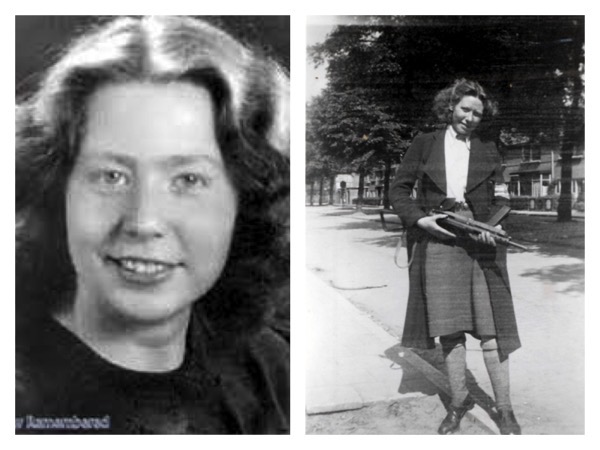
Hannie Schaft with SOE supplied Sten Gun
It was often easier for women to talk their way through German checkpoints whilst transporting weapons, underground newspapers and carrying messages; there are accounts of young women walking hand-in-hand with Jewish children whilst escorting them to safe houses whilst appearing as an older sister walking with a sibling, and there are several accounts of female members of the resistance seducing German soldiers to obtain intelligence before luring them to remote areas and killing them. After the war Truus Oversteegan said she compared the Nazi regime as “cancerous tumours in society that had to be cut out like a surgeon… For Hannie, Freddie and me there was no other solution than to resist, fighting fire with fire… That is the cruelty of war.
Teenage Assassins
It was in Haarlem, a city outside Amsterdam in northwest Netherlands, where the three teenagers: Truss Oversteegan, her sister Freddie and Jannetje Johanna ‘Hannie’ Schaft killed collaborators and German soldiers. The Oversteegane sisters started their resistance activities by distributing anti-German flyers and newspapers before becoming skilled assassins. The three women shot dead Dutch collaborators who were giving the names of Jewish families to the German authorities and they were killed in the street during daylight to act as a deterrent. They also flirted with collaborators and German soldiers and took them to woods and shot them, and the thrree were also involved in street shootings from bicycles so they could get away quickly.
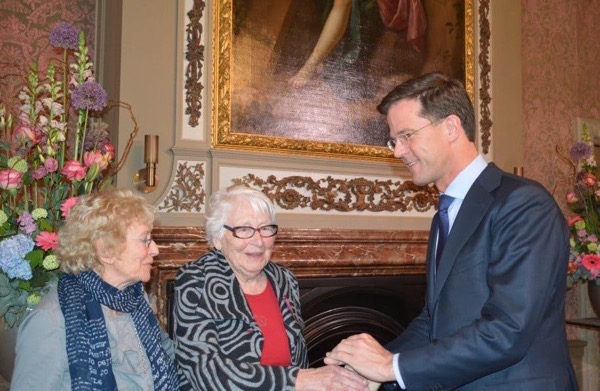
The Oversteegan sisters after the war
The Oversteegan sisters survived the war, married and had families but Hannie Schaft who had distinctive red hair was captured and executed on 7 April 1945. It is known at one point she dyed her hair black and assumed the name Johanna Elderkamp but by this time she was too well known by the Gestapo.
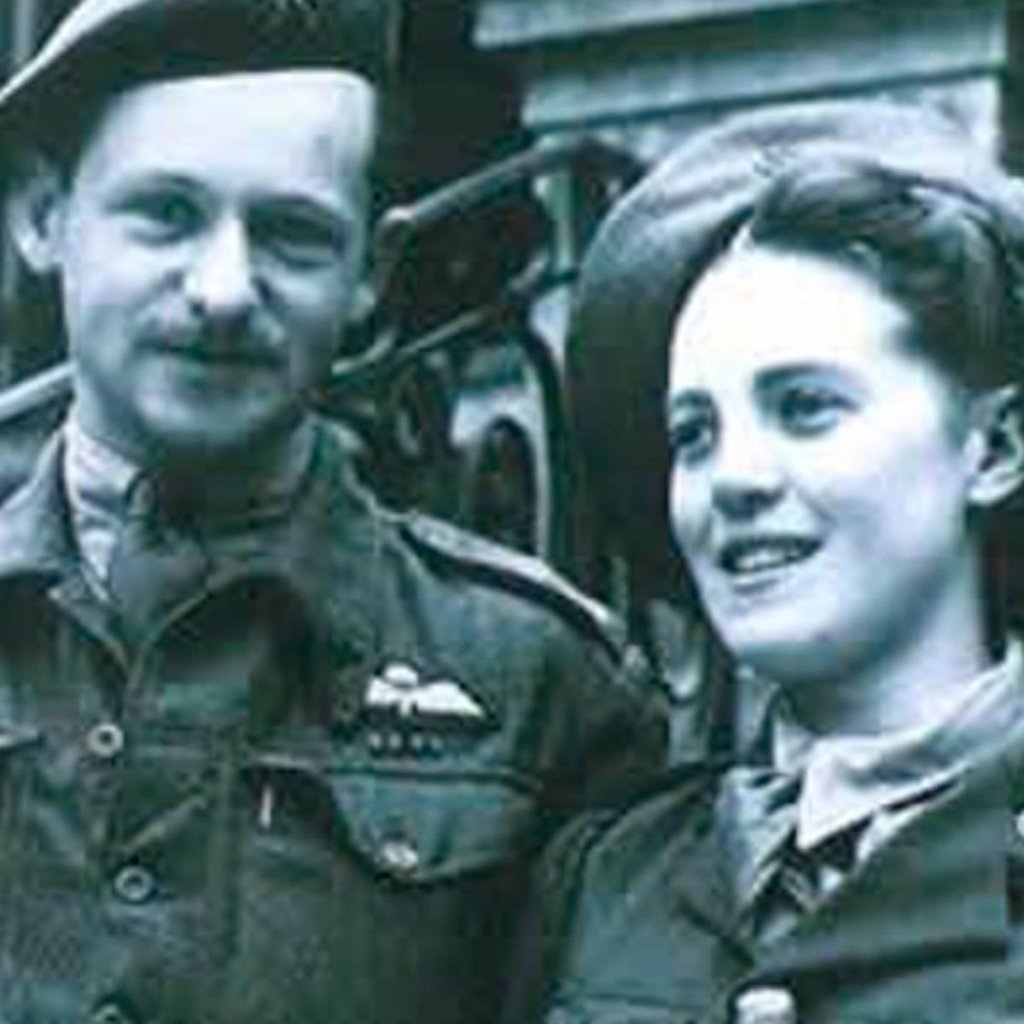
‘Michou’ Dumon with her husband, Pierre Ugeux who served with SOE (Comete line)
Micheline Dumon (code names Lily and Michou) served with the Belgium Resistance and worked on the Comet Escape Line and her surname often appears misspelt as ‘Dumont’.
As a member of Comet, she helped allied aircrews shot down over Belgium and France evade capture and was credited for assisting 250 aircrew by guiding them through Belgium and France to neutral Spain, and is noted for being one of the most experienced and longest serving member of the escape line.
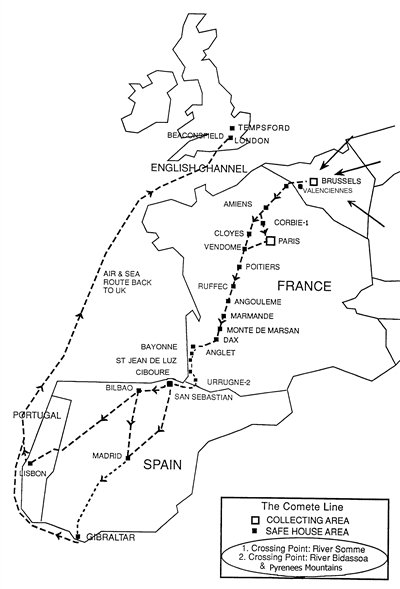
Comet Escape Line
In August 1942 her father who also worked on the Comet Line was arrested by the Gestapo and deported to a concentration camp where he later died.
In 1944 the line was infiltrated by a double agent named Jacques Desoubrie a Belgium working for the Gestapo infiltrating resistance groups in Belgium and France and after finding herself on the Gestpo wanted list was forced to escape to England where she spent the remainder of the war training MI9 agents.
After the war Micheline Dumon said, “I knew a lot of people and I moved around a lot. I never stayed in one place, and so I was always alone. Also, I was lucky.”
Andree Dumon
Andree (code name Nadine), Micheline Dumon’s sister, was in charge of safehouses where aircrews were hidden until they could be moved down the line and she also prepared false identification cards and connected escapers with escorts to take them from Belgium to neutral Spain by bicycle, train and on foot. After a narrow escape from the Gestapo, she went underground and lived in a safehouse for several weeks and obtained false identity papers which said she was 15-years-old and accoding to several airmen she looked about 12 or 13 and dressed accordingly. She also spoke English and interacted with allied airmen who rarely spoke French.
In June 1943 the Comet Line was close to collapse after many arrests by the Abwehr and Gestapo and Andree Dumon took on a leadership position which she described as “A sort of odd-job woman: looking after safehouses, escorting aircrews, recruiting new agents, collecting food coupons and repairing escape routes after waves of arrests.”
By January 1944 it was too dangerous for her to remain in Brussels so she moved to Paris and then to Bayonne in southwestern France to work with Elvire de Geer who was the leader of that end of the line during which she escorted two groups of 10 allied airmen across the Pyrenees to Spain, and in March 1944 she was one of three Comet Line leaders who attended a meeting in Madrid with senior MI9 officers to plan their activities for D-day.
After the meeting she went to Paris and shortly after arriving was arrested by the French police and spent two nights in jail. From the time she was in police custody she behaved like a young girl and the way she was dressed supported the deception and instead of being handed to the Gestapo the police commandant released her becuase she was a child. After this close escape she found a new safehouse and continued her resistance work until France and Belgium were liberated.




 Alan Malcher