Shell Shock has been described as a reaction to to the intensity of bombardment and fighting that caused a feeling of helplessness that could result in panic, fear, flight or an inability to reason, sleep, walk or talk. It was also referred to as bullet air, soldier’s heart, battle fatigue, war neuroses and operational exhaustion.
As seen in this short clip by Pathé News Shell Shock sometimes caused serious damage to the nervous system.
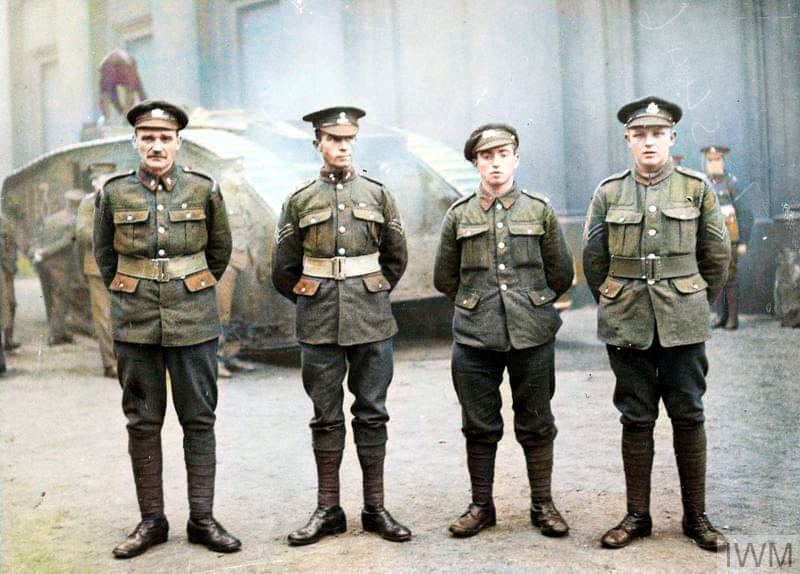
The Battle of Mons was the first major action of the British Expeditionary Force of the First World War. It was a subsidiary action of the Battle of the Frontiers, during which the allies fought the Germans on the French border.
I don’t know the source of this short film documentary and consequently I am unable to credit the film maker.
I would like to thank Dr Christine Quintlé for the following information.
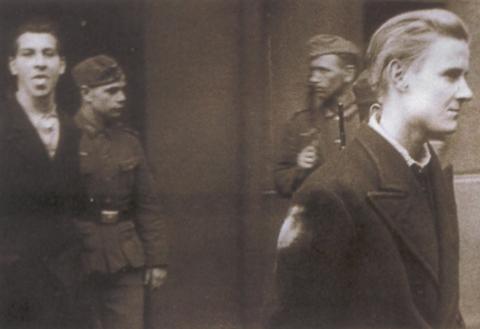
Twenty seven members of the French Resistance being taken away for execution after a trial before a German military tribunal in Paris on 14 April 1942.
The trial has been called “Procès de la Maison de la Chimie” (trial of the House of Chemistry) as it took place there. Twenty-three of the accused were executed on 17 April at Mont Valérien. André Kirschen, the son of a Romanian Jews was only fifteen at the time of the trial and could not be sentenced to death under German military law. Simone Schloss, who was Jewish, was beheaded in Cologne on 2 July 1942. The image is as still from a German propaganda film.
The young man sticking his out tongue out in defiance after the trial is Jean Quarré who had been with the students and school teenagers who demonstrated against Germany at the Quartier Latin, Paris on 14 July 1940 and on the on the Grands Boulevards, Paris on 13 August 1940. He joined the Résistance in 1941. The other man is Karl (Carlo) Schoenhaar.
Colourised image by DB Colour but original B&W source not indicated.
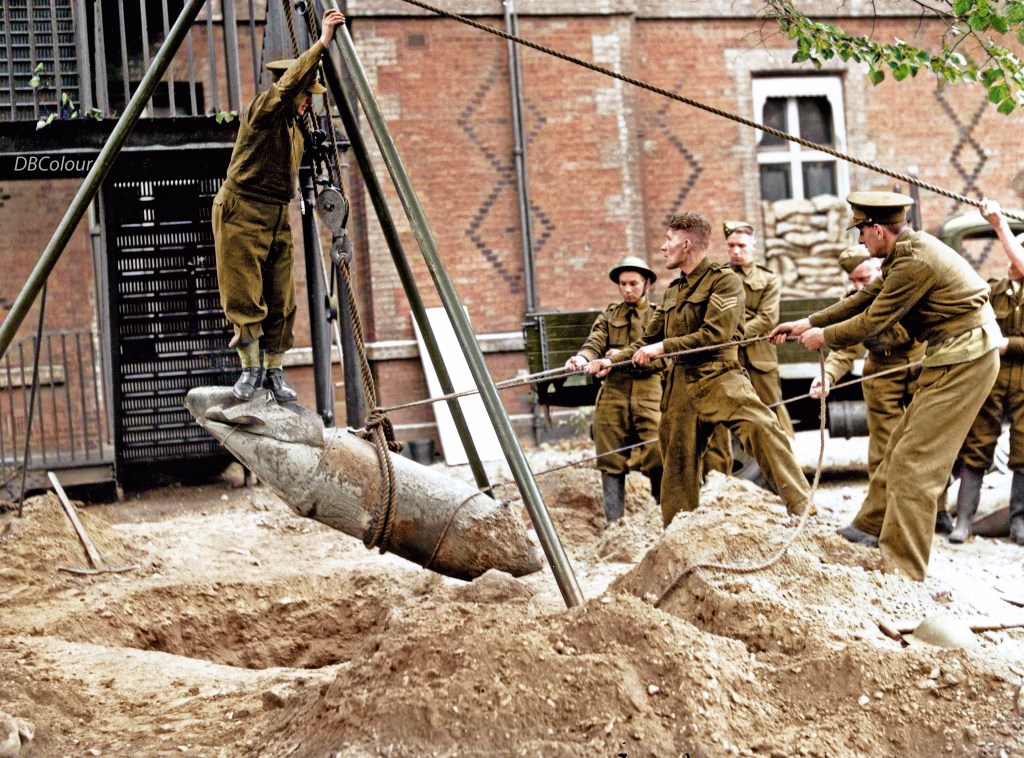
Lieutenant Robert Davies GC, Royal Engineers standing on a 1,200 lb bomb after a Luftwaffe air raid on London. Photograph taken on 25 November 1941 in Dalston, London after Davies defused the bomb.
Colourised image by DBCoour. Original B&W source not listed)
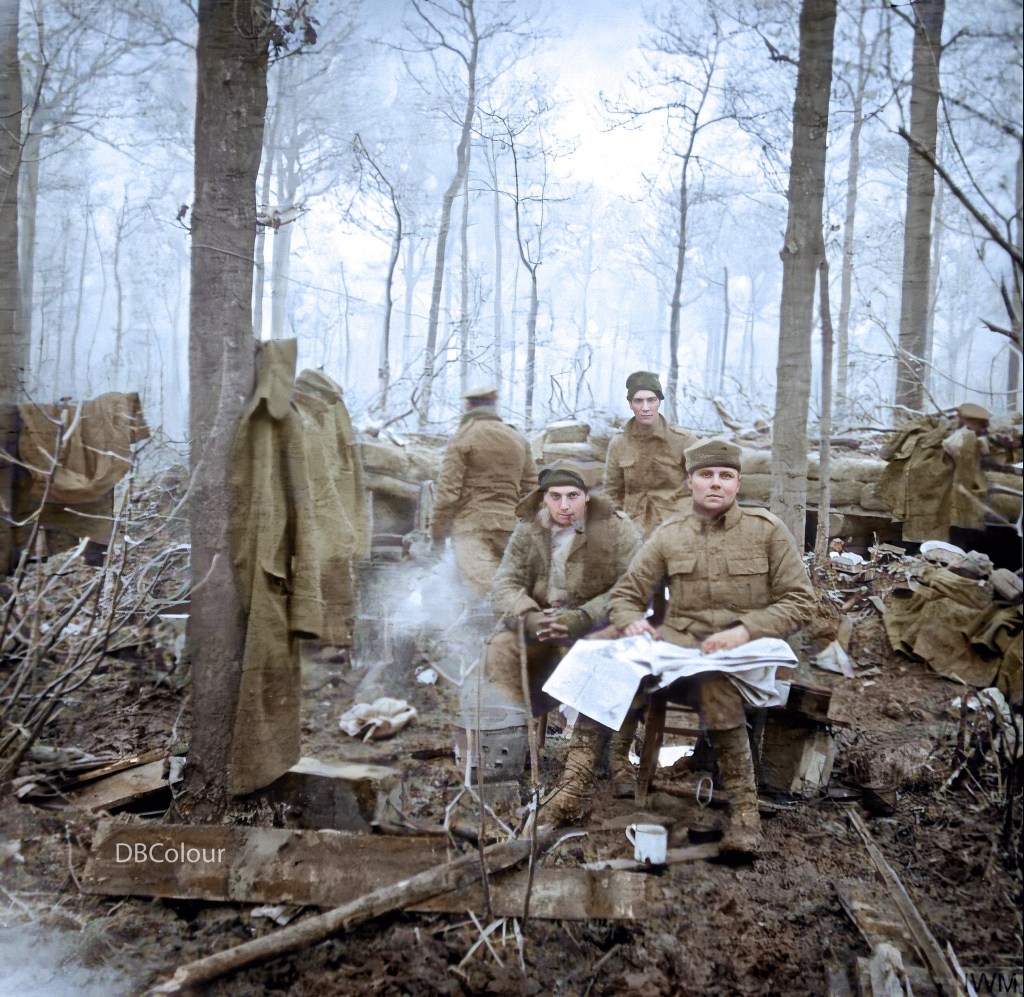
Members of the London Rifle Brigades in Ploegstreet Wood, Armentieres Belgium. According to the London Rifles Association during the Great War 10,016 were killed during enemy action, 2,644 wounded and 303 captured. Part of the wood is now used by the Commonwealth War Greaves Commission.
Whilst looking for German shipping hiding in Norwegian fjords, Coastal Command aircraft were forced to dive steeply between precipitous, snow-capped mountains. On December 5th, 34 Mosquitoes of Coastal Command, Banff Wing, armed with cannon and rocket projectiles, attacked enemy shipping lying in the eastern end of Nordgulen Fjord Norway. The aircraft dived from a height of 5,000 ft to mast height at an angle of 45 degrees at a speed of over 300 miles an hour. They also had to run the gauntlet of flak from merchant vessels averaging 3,000 tons each and two escort vessels were attacked – all the ships were left burning. (Film includes good aerial shots of a Mosquito of No. 248 Sqn RAF and attacks on ships in fjord.)

 Alan Malcher