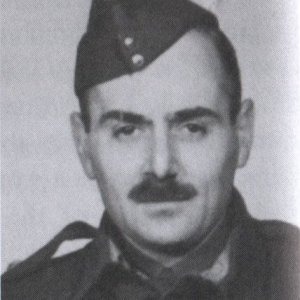
Eugene Bec (field names Hughes, Borer, Raymond Perrin, Francis Eugene Labrousse) was born in England and had duel British and French nationality. He received his secondary education in Boulogne and served with the French Air Force between 1925 and 1927. When was was declared in 1939 he joined the French Army and was attached to the French liaison staff with the British Royal Armoured Corps in France and after failing to be evacuated during Operation Dynamo (Dunkirk) he eventually escaped to England in 1942 and began his SOE training the same year.
On 28 May 1944 he arrived in France by parachute to join HEADMASTER 2 circuit as their weapons instructor which was operating in the Sarthe department and according to reports this was an agricultural area that had not suffered from the German occupation and this not only made recruitment difficult there were also limited areas where weapons could be dropped and hidden. Despite these setbacks HEADMASTER 2 formed two large resistance groups in the Forêt de Charnie and Forêt de Berc and from these areas the circuit conducted sabotage operations in and around Le Mans.
On 15 June 1944 members of HEADMASTER 2 were captured by German forces and handed to the Gestapo and after being tortured a member of the circuit called Philippe was forced to provide the location of the resistance base in the forest and the following day over 100 German soldiers attacked Bec’s encampment and after killing the German commander and fourteen of his men during a firefight Bec and his men were forced to withdraw. During their escape Bec and three members of the resistance were ambushed and killed and their bodies were later recovered by the resistance and buried in a graveyard in Le Mans. The ceremony was photographed by surviving members of HEADMASTER 2 and a copy was sent Bec’s father who was living in Ruislip, Middlesex. The photograph showed three coffins, two draped with the Tricolour the other with a Union Flag. The graves were covered with flowers to show, as Buckmaster (Head of F Section) later wrote “how grateful the French appreciated the gallantry of the British officers who had volunteered to work with them”.
 Alan Malcher