(Text and photograph from Facebook account: British & Commonwealth Forces Past, Present and Future – I have no connection with this account.)
Operation Banner (Northern Ireland) 1969- 2007
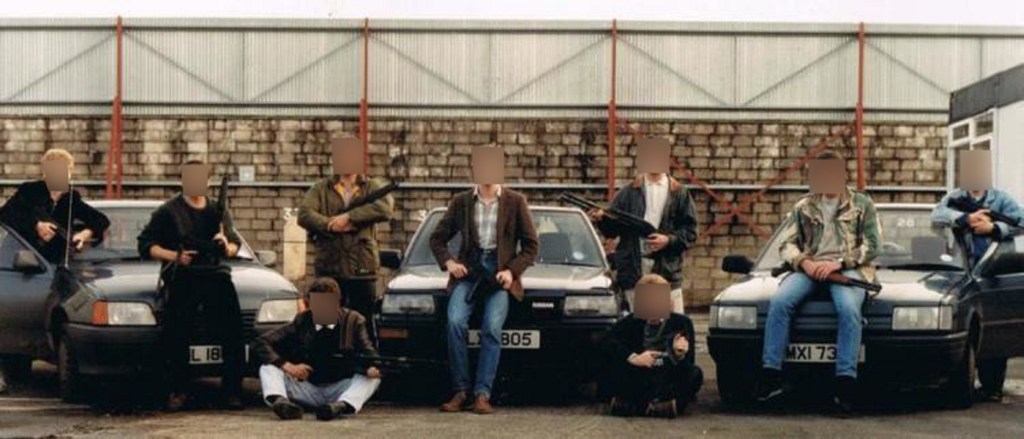
Force Research Unit operators pose for photograph.
“The Force Research Unit (FRU) was a covert military intelligence unit of the British Army’s Intelligence Corps. It was established in 1980 during the Troubles (Operation Banner) to obtain intelligence from terrorist organisations in Northern Ireland by recruiting and running agents and informants.
From 1987 to 1991 the FRU was commanded by Major {name deleted} of the Intelligence Corps and was renamed the Joint Support Group in the early 2000’s.
FRU worked alongside existing intelligence agencies including the Special Branch of the Royal Ulster Constabulary and MI5 (Security Service) and in 1988 the All Source Intelligence Cell was formed to improve the sharing of intelligence between the FRU, Special Branch and MI5.
The author claims FRU was granted special privileges in the course of their work, such as the power to overrule senior officers in ordering an area to be cleared of regular security force patrols or by requesting immediate helicopter cover.
The FRU also had the power to designate specific properties as “off limits” to RUC searches in order to protect agents or the intelligence documents the agents were in control of.”
CAVEAT – the above is from an unknown Facebook and Youtube contributor.
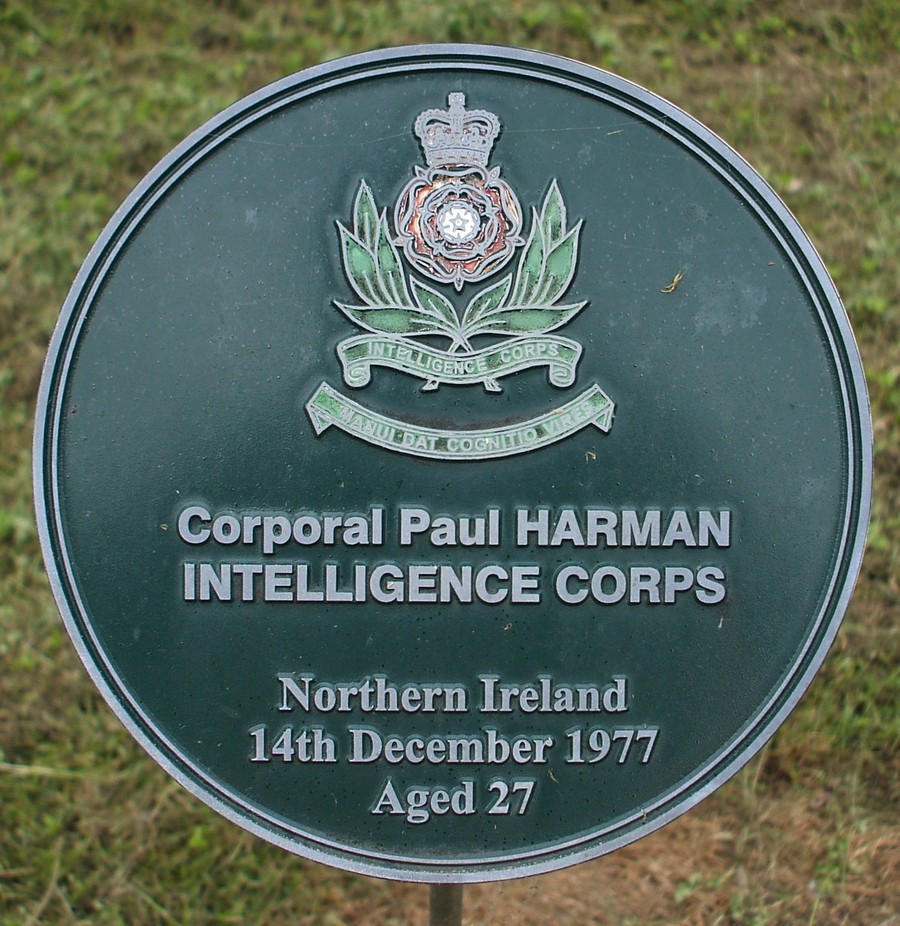
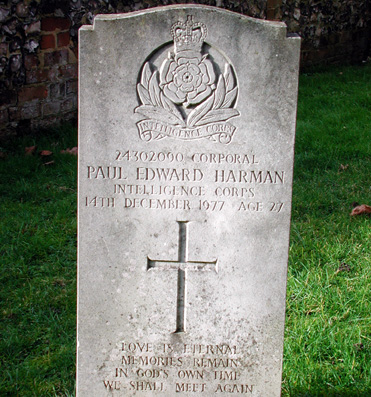
Corporal Paul Edward Harman was killed during operation Banner (Northern Ireland) on 14 December 1977.
Paul was alone whilst driving an unmarked civilian vehicle along the Monagh Road in the Turf Lodge area, when he was stopped by members of the Provisional Irish Republican Army. As he attempted to escape, he was shot dead by the terrorists.
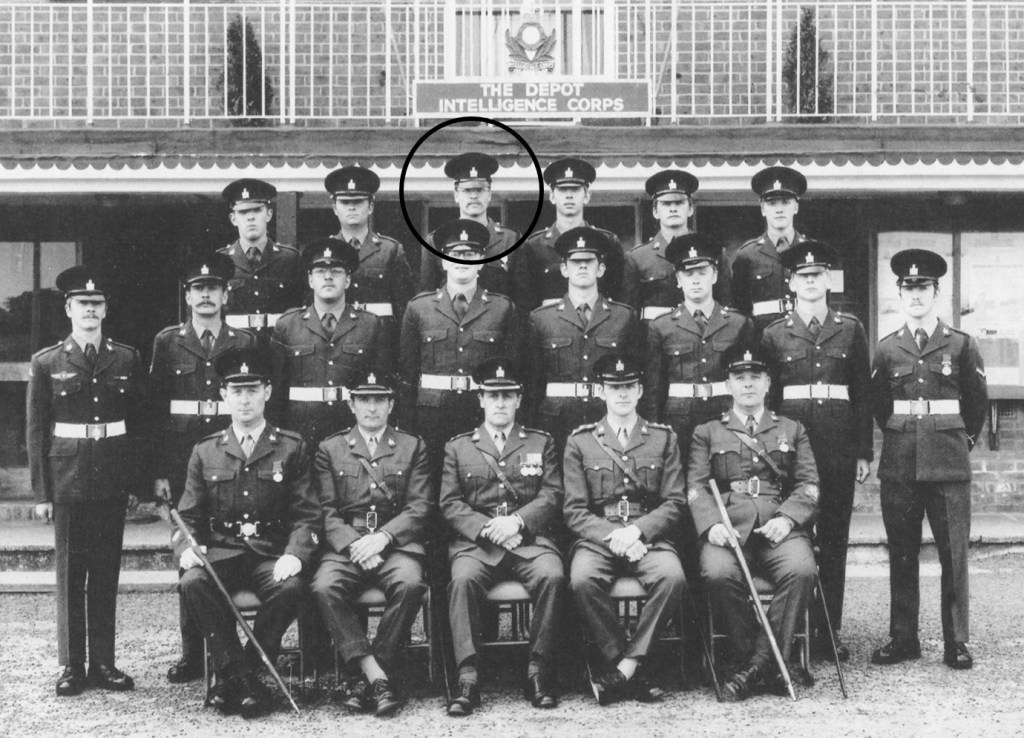
Paul, the son of a diplomat, was born in Ankara, Turkey on 15 April 1950. He originally joined the 16th/5th Lancers (regimental number: 24302090) and served in Cyprus during the Turkish invasion of the island. He transferred to the Intelligence Corps on 15 May 1975 (photograph of Squad 57 attached), and having been selected for special duties he was posted to Northern Ireland and was 27 years old on the day he died.
He was the only member the Corps to be killed in action during operations in Northern Ireland (Operation BANNER). In his memory, the trophy awarded to the winning team at the Corps’ annual football tournament was renamed the Harman Trophy.
Our thoughts are with his family and friends.
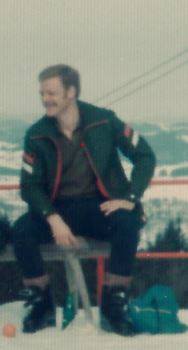
(Image: Paul on Exercise SNOW QUEEN 1975.)
Above text and images from the Intelligence Corps.
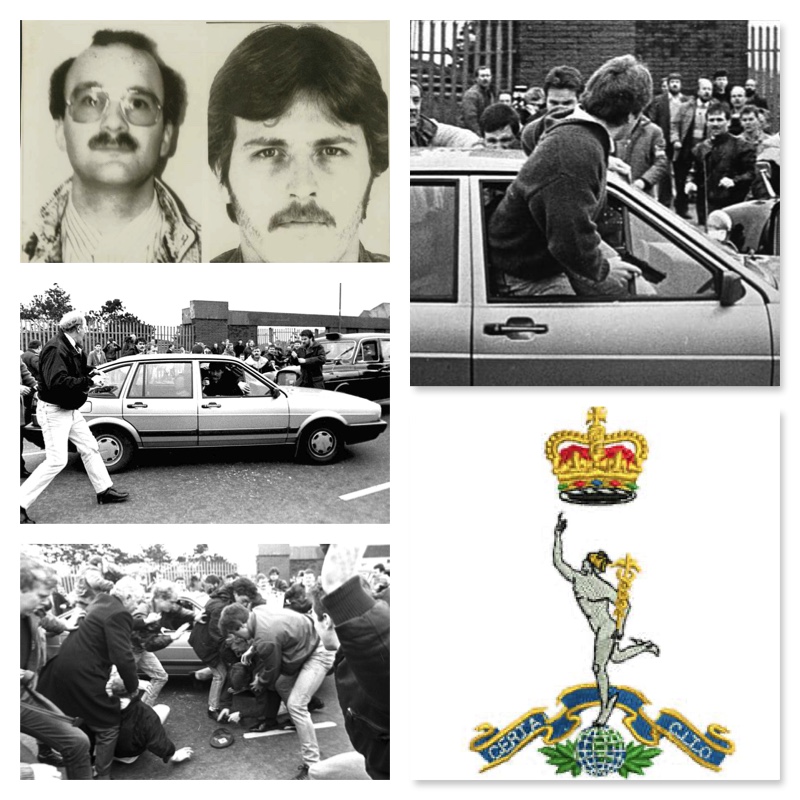
Operation Banner (Northern Ireland). On 19 March 1988 Corporal Derek Wood, aged 24, and Corporal David Howes, aged 23, both serving with the Royal Signals, were wearing civilian clothes and driving a silver Volkswagen Passat with civilian number plates after completing repairs of signal equipment at a military base and were returning to their barracks. After taking a wrong turning they came across a large IRA funeral procession and attempted to reverse in the opposite direction, but their escape route was quickly blocked by a taxi and a car. Their vehicle was then attacked by a crazed mob, Derek Wood fired a round from his Browning HP pistol in an attempt to scatter the mob, but both were quickly overpowered and dragged from their car. Wood and Howes were taken to a sports ground where they were stripped and beaten before being taken to waste ground and shot. Two men were sentenced to life imprisonment for murder but released in 1998 under the Good Friday Agreement. Certa Cito. RIP!
Thomas John Bingham aged 29 and William Richie Savage from East Belfast were travelling in an unmarked police car on Newry Road when they were killed by a 1000 lb bombed detonated 600 yard away.
Intelligence operations during Banner remain a closely guarded secret, true accounts have often been replaced by Sinn Féin/IRA propaganda and the Four Square Laundry is a good example of the propaganda found in pro- Sinn Féin/IRA publications.
To combat terrorism by the Provisional Irish Republican Army (PIRA) in 1972 the British Army created the Mobile Reaction Force (MRF). This clandestine unit was based at Palace Barracks, Hollywood Northern Ireland and consisted of around forty men and women from the army who were specially trained and selected for intelligence and surveillance operations which journalist at the time called plain clothes soldiers.
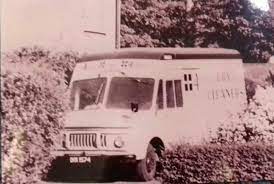
Four Square Laundry (Intelligence Museum)
Four Square Laundry collected washing from parts of Belfast where terrorists were known to live and before being cleaned and returned to customers were forensically examined for traces of explosives and gunshot residue.
Double agents Seamus Wright and Kevin McKee.
Two MRF double agents, Seamus Wright and Kevin McKee, were discovered by PIRA and whilst being tortured for information provided details about the army operation, both were later shot in the back of the head and their bodies were thought to have been buried somewhere in the border region of South Armagh.
Sapper Edward Stuart (Royal Engineers whilst serving with MRF)
On 2 October 1972 the laundry van was being driven by Edward Stuart whose home unit was the Royal Engineers and was accompanied by Lance Corporal Sarah-Jane Walker. Walker was returning laundry to a customer and standing at their front door when a car drew close to their van, three gunmen got out whilst the driver remained in the car ready for a quick getaway and Sapper Edward Stuart was killed instantly by automatic weapons thought to be Kalashnikovs recently supplied by Colonel Gaddafi of Libya.
According to Sinn Féin/IRA propaganda Sarah-Jane Walker ran into the house hysterically screaming Protestant paramilitaries were trying to kill them and was given refuge, but this is not true. During the first sound of gunshots Walker turned round, faced the terrorists and engaged them with her 9mm Browning HP automatic pistol and the gunmen fled. Plain clothes officers from the Royal Ulster Constabulary in an unmarked car quickly arrived and secured the area. It is also not true undercover soldiers were hiding in the roof of the vehicle and were killed or wounded, Stuart and Walker were alone when they were ambushed. The following year, Sarah-Jane Walker, which for security reasons is not thought to be her real name, was awarded the Military Medal by the Queen and the first awarded to a WRAC serving in Northern Ireland.
According to the Guardian dated 8 September 2015: “DNA tests have confirmed the remains of two bodies found in an Irish bog are those of Séamus Wright and Kevin McKee, two of the IRA’s “disappeared.
The men, who were members of the Provisional IRA in west Belfast, vanished in 1972. They were believed to have been kidnapped, interrogated, then shot dead by the PIRA. Their bodies were buried in secret across the border in the Irish Republic.
The organisation in charge of locating the remains of 17 people whom the IRA killed and then disappeared during the Northern Ireland Troubles said DNA examination of samples taken from the bog in County Meath proved they were Wright and McKee.”
The number of military and police casualties during Operation Banner (14 August 1969 to 31 July 2007) vary according to sources with one source stating 1,400 soldiers and 319 Royal Ulster Constabulary Officers were killed and 6,100 members of the security forces injured.
The first soldier killed during Operation Banner was 20 year old Robert Curtis serving with the Royal Artillery who was shot in the New Lodge area of Belfast on 6 February 1971.
The last army fatality was 23 year old Stephen Restorick serving with the Royal Horse Artillery who was shot whilst manning a checkpoint at Bessbrook, South Armagh in February 1997. His killer was found guilty of multiple murders and bomb plots and sentenced to 490 years in prison, but was released after serving 16 months as part of the Good Friday Agreement! The Good Friday Agreement allowed all convicted terrorists to be released from prison and those on the run received comfort letters. Many Banner Veterans and their supporters accuse the British Government under Prime Minister Tony Blair of betrayal and persecution after several former soldiers fifty year after alleged events appeared in court.
Many veterans also resent Tony Blair for knowingly lying to Parliament and the British people when he said Iraq under Saddam Hussein had weapons of mass destruction (WMD’s) to obtain approval for an illegal war against Iraq.


 Alan Malcher