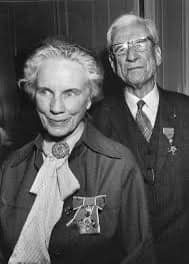
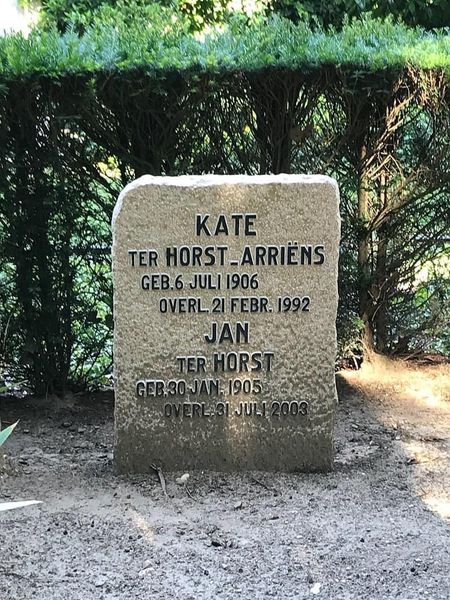
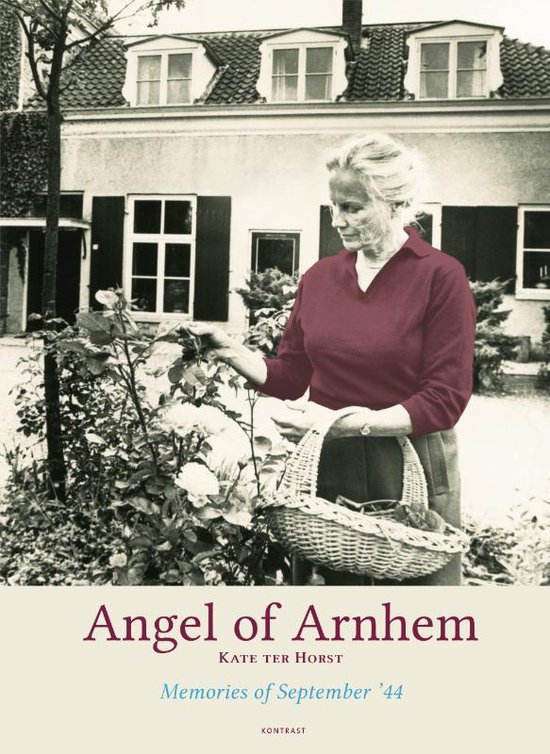
During the ill-fated Operation Market Garden (17-26 September 1944) the British 1st Airborne Division suffered heavy casualties fighting in the Dutch city of Arnhem, the town of Oossterbeek, the villages of Wolfheze and Driel. Kate Ter Horst, described as a housewife and mother, turned her house into a makeshift hospital for the wounded and dying. She personally helped 250 wounded soldiers and gave comfort to the dying by sitting with them until they died and earned the nickname ‘The Angel of Arnhem’ and was later depicted in the film ‘ A Bridge Too Far’. In 1947, despite extensive mine clearance after the war her eldest son Peter was killed by an undetected anti-tank mine. On 21 February 1992, 98 year old Kate Ter Horst MBE died after being hit by a car near her home.
The Taxi Charity for Military Veterans was formed in Fulham, London in 1948 and the charity is reliant on public donation, businesses and trusts. An amazing group of London taxi drivers volunteer their time and vehicles to transport veterans to events free of charge. More information will be found at the bottom of this page.
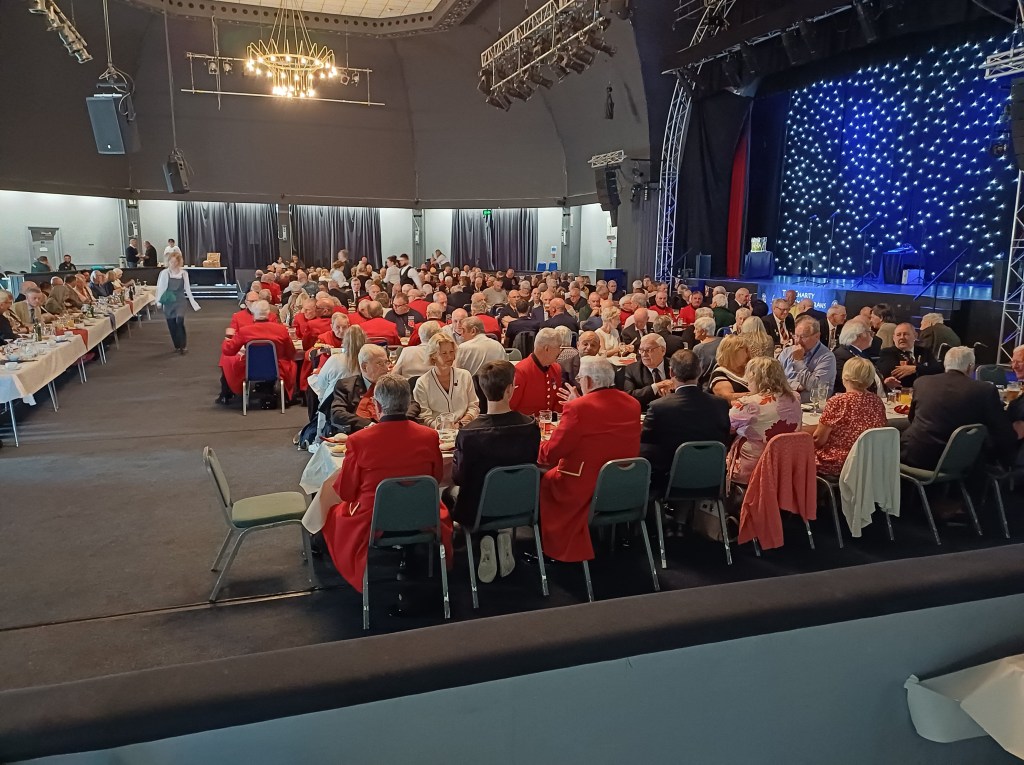
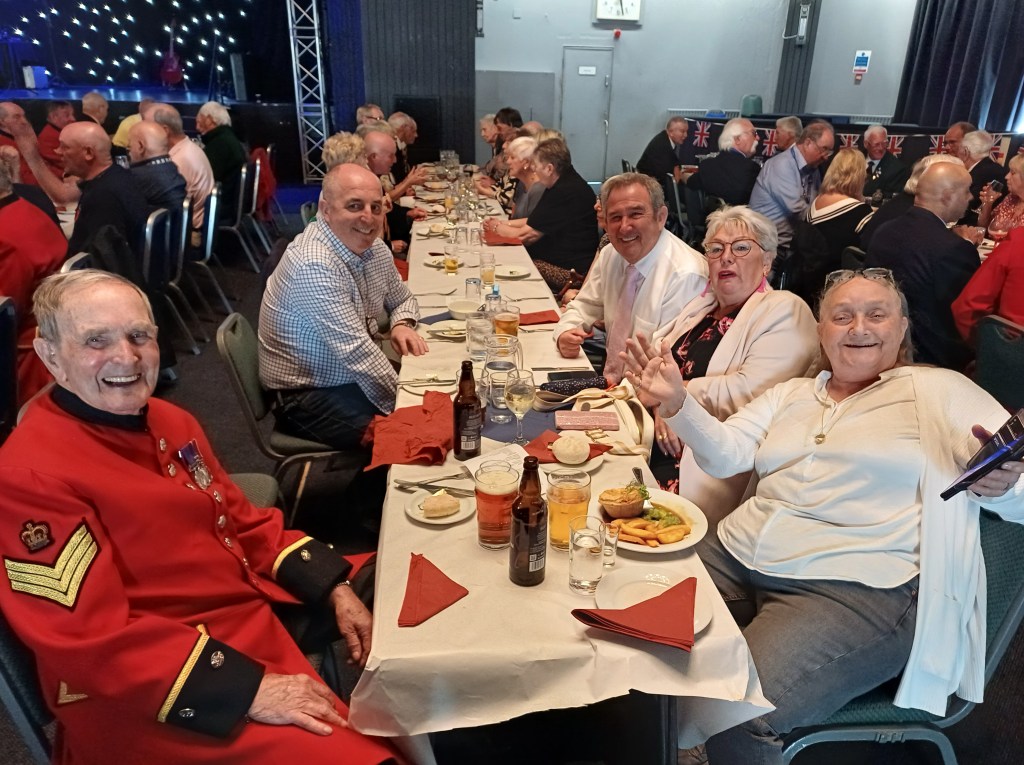
On 2 July 2024 it was a great privilege to be invited to the Taxi Charity annual fund raising dinner in Worthing, Sussex during which transport was provided by 100 London taxies. On the way to the venue in Worthing and on the way back the taxies stopped at the small village of South Holmwood near Dorking where villagers each year provide free refreshments and show their appreciation.
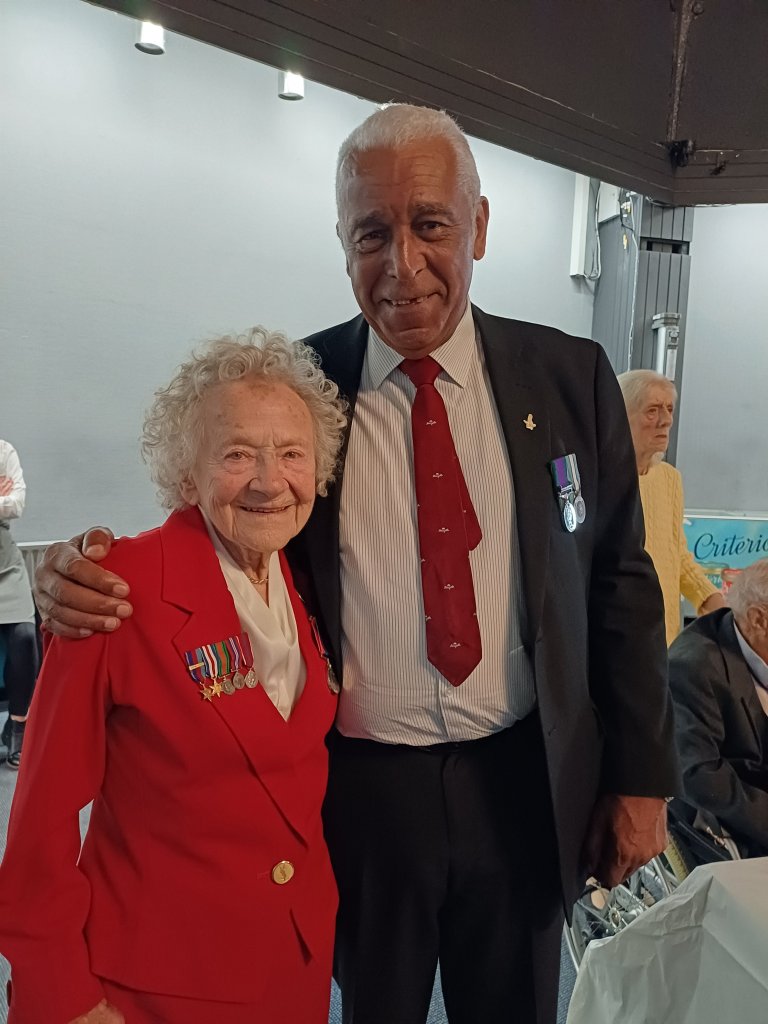
I spoke to may remarkable men and women including 99 year old Dorothy Barron who served with the WREN’s as a signaller during WW2.
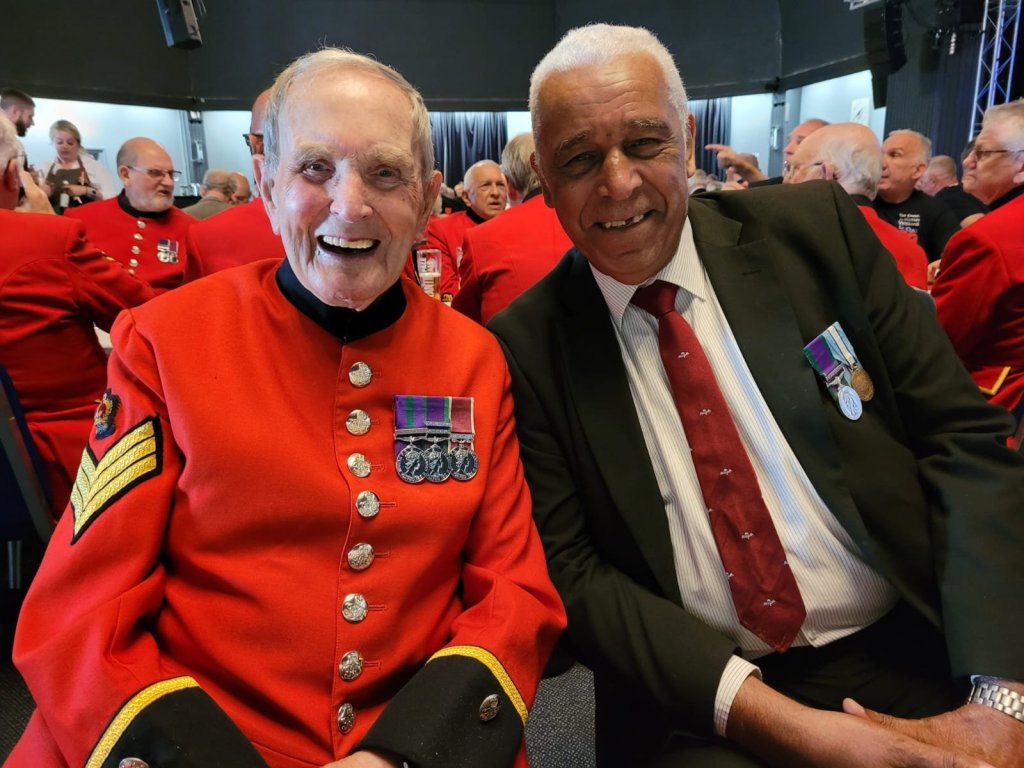
Walter from the Royal Hospital Chelsea (Chelsea Pensioner) who I spoke to over dinner and a few pints.
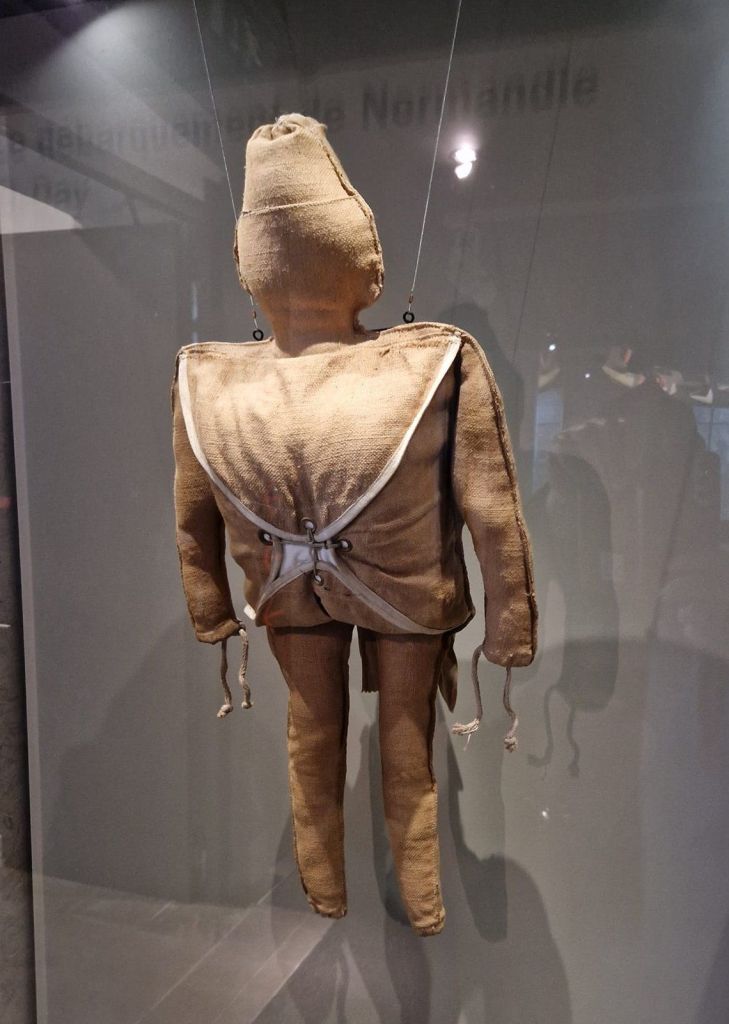
Parachute dummies were an important aspect of the Allies’ deception plan for the Normandy Landings. They were nicknamed ‘Rupert’s’ by British troops. It is sometimes suggested they were named after the cartoon character Rupert the Bear. Approximately 500 Paratrooper dummies were dropped as decoys to divert and distract German forces, in what was codenamed Operation Titanic. This was part of a broader deception plan for D-Day, designed to give the Allied invasion force the element of surprise and the best chance of victory. (Image Musée Militaire Paris)
Actor Richard Todd took part in Operation Tonga on what is now known as D-Day. 60 years on in 2004, he revisited the landing site in Normandy and reflected on his experience. Richard Todd, who was born in Dublin, served with the British 6th Airborne Division and was among the first British soldiers to Land in Normandy and was the first Irishman. The following is from the BBC archives.
It was a great pleasure to be invited to attend Founder’s Day at the Royal Hospital Chelsea where the reviewing officer was Her Royal Highness The Princess Royal, after being inviting by Tony Millard noted for his many years of continued charitable work supporting veterans.
Chelsea Pensioners and guests were given an oak leaf to wear symbolising the oak tree where Prince Charles, later crowned Charles II, hid after the Battle of Worcester during the English Civil War (c1642-1651) when Parliamentary troops were searching for him. After the restoration of the monarchy, in 1681 King Charles II issued a Royal Warrant to build a hospital for those ‘broken by age and war’ which later became know as the Royal Hospital Chelsea. An added bonus was briefly meeting for the first time Dr Gogna from Australia who recognise me, knew my name and thanked me for my historical articles of remembrance. After this I attended an informal celebration of D-day (Normandy Landings) at Tony and Sue Millard’s pub called the Clarence at 148 North End Road West Kensington, London where the proceeds of a raffle went to the London Taxi Charity which has been supporting veterans since 1948.
As this was a traditional London celebration I apologise for the short clip of me attempting to dance!
Tony and Sue Millard – who continue to support veterans.
Sue Millard and Me.
One of the locals.
Locals at the Clarence public house remembering D-day (Normandy Landings).
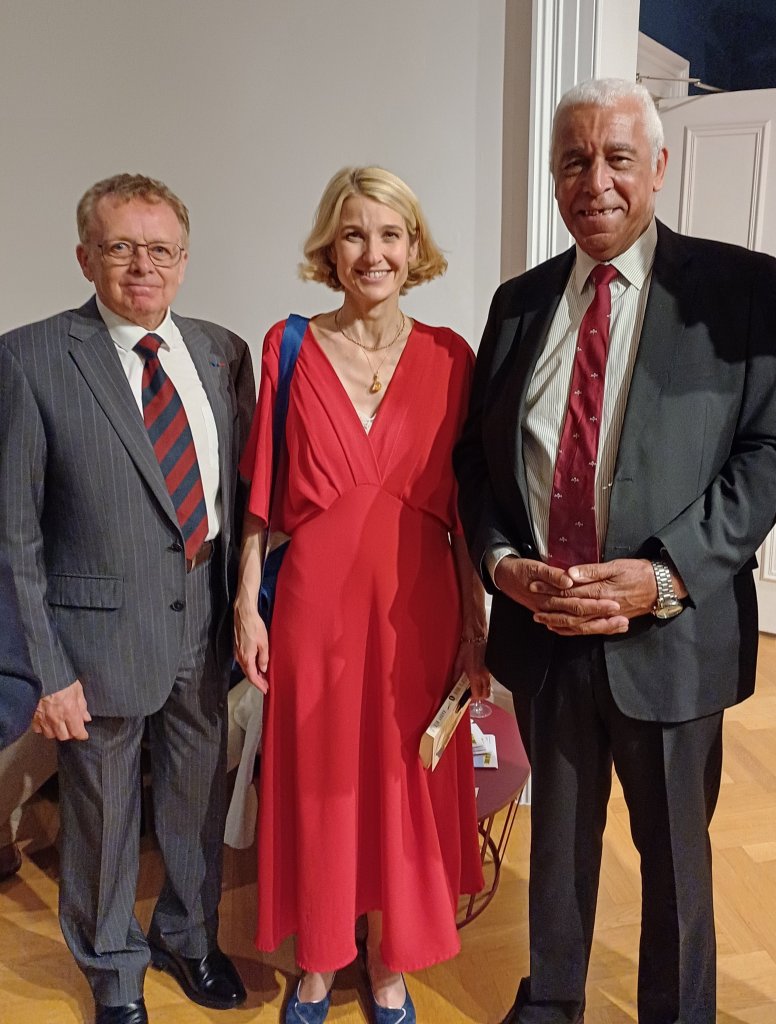
Ian Reed MBE Lég d’Hon, Cécile Coolen, Alan Malcher. At Institut français du Royaume-Uni. 31 May 2024.
I was honoured to receive an invitation from Héléne Duchéne Ambassador of France to the United Kingdom via Ian Reed MBE Lég d’Hon to a special viewing of On His Majesty’s Secret Service a film about SOE in occupied Europe by Cécile Coolen. It was also a pleasure meeting Cécile Coolen and others during the reception.
Cécile Coolen is a French film director and chief editor of over 100 films recognised at the Hollywood Film Festival, Emmy Awards, Prix Europa, New York Festival, and she specialises in archive documentaries particularly connected with wartime intelligence services.
“Cécile Coolen has a clear understanding of the subject and the ability to present the story of our collaborative intelligence activities, an issue which is still inadequately understood” (Sir John Scarlett KCMG OBE, former Chief of SIS/MI6)
“Her wealth of professional experience, combined with knowledge of the intelligence world shines through in this film, giving this story the dimension and impact it deserves.” (Alain Juillet, former Chief of DGSE – French Intelligence Service)
Leo Marks (24 September 1920- 15 January 2021) was born to a devout Jewish family in London. His father was joint owner of Marks and Co and was an antiquarian bookseller in Charring Cross Road, London. Marks joined the army in January 1942 and was sent to Bletchley Park as a codebreaker where he was regarded a misfit. However, SOE saw him has as one of a few unique people who could see patterns and codes that most people would miss. A modern description being ‘he could see so far out of the box most people even with a powerful telescope would miss it’.
As head of SOE’s European Country Sections codes and cyphers he was based at Mitchel House Baker Street, London with a staff of over 400 and was responsible for proving wireless trained agents operating in countries under occupation with cyphers which included various identity and security checks when sending signals to London.
He also provided every agent with a poem code to transpose text into coded messages and the most famous of his poem is ‘The life that I have’ used by Violette Szabo GC who refused to reveal it to the Gestapo after her capture.
Like many films and books about SOE ‘Carve Her Name With Pride’ was promoted as the true story of Violette Szabo but was heavily dramatized and had many historical inaccuracies including the claim her poem code was written by her husband who had recently died, this was among many books and films heavily criticised by former SOE agents and staff officers and these inaccuracies continue to be duplicated by authors and film makers.
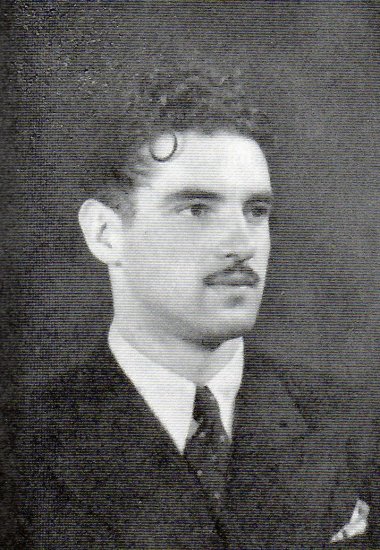
24 year old Alexandre Schwatschko aka Alexander Shaw
Alexandre Schwatschko was born in Russia on 19 July 1919 to a wealthy family with property in the Ukraine and during the Bolshevik Revolution (8 March 1917 to 6 June 1923) the family moved to France. When war was declared in 1939 he enlisted into the French Air Force and served as a pilot until the fall of France in 1940.
After being demobilised under the terms of the armistice he eventually escaped to England through Spain. During his SOE training he was known as Alexander Shaw and because of his flying experience was selected for training as an air landing officer to assist pickup pilots to deliver and extract agents from remote farmland during the moon period.
Air landing officers were trained by the RAF in the technical specifications required for the type of aircraft they would be assisting and after arriving in France were responsible recruiting and training reception committees who were members of the resistance known as ‘torch men’ although many women were also used. These committees were essential because they were responsible for displaying lights in a recognised pattern indicating wind direction, glide path and other information to allow the pilot to approach and land during the moon period without landing lights.
In February 1944 Shaw arrived in France to work for Maurice Southgate’s STATIONER circuit to organise pickup operations by Lysander aircraft. After training his reception committee he identified ten fields fitting the technical and security requirements for Lysander operations and the coordinates were sent to London by wireless. He was responsible for a large number of air landings under difficult conditions and was mentioned in despatches.
Agents were accustomed to being routinely questioned at checkpoints and were trained how to react during their training at the Beulieu finishing school. It is known Shaw was stopped at a checkpoint by German soldiers near the hydro-electric dam in Barrage d’Éguzon, approximately 30 kilometres north of Limoges on 7 June 1944, but there is no explanation why he was arrested and taken to a local police station. After being arrested agents were taught to remain clam, keep to their cover story and there are many recording accounts of agents being released using this procedure.
Why Shaw attacked and killed a German officer during which he was shot dead is not known and according to the Commonwealth War Graves Commission he was buried the following day at a Cemetery in Éguzon.
Christopher James Lord was born in Birmingham, England on 27 October 1900. He was recruited by SOE in 1942 whilst working for the Guaranty Trust Company of New York after previously working for American Express in Paris and his wife was serving as a lieutenant with the Free French based in London.
It is known Lord arrived in France on 15 April 1943 with instructions to organise the courier network between Belgium, France and Britain and three days after his arrival Lord recruited two sub-agents named Albert Lefevre and Jean Chudeau. Lord is though to have met his two new recruits on 14 May 1943 at the Café de la Gare in Carmaux after which he was not heard of again.
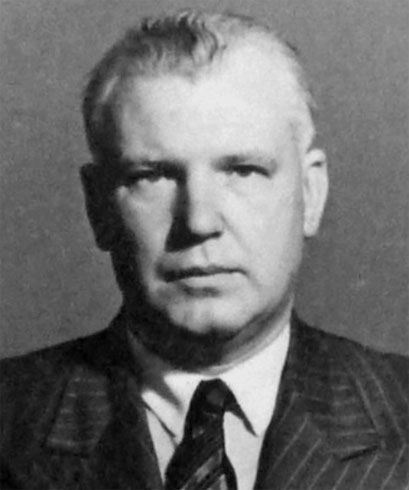
After the war his wife published his photograph in a Carmaux newspaper and asked for information about his disappearance but there were no replies. In March 1946 she was informed that in 1943 an unidentified body had been found in a well in a small village near Carmaux that had been buried locally. The police were aware the unidentified man had been shot four times with a Colt revolver that was dumped with the body in the well, they were convinced he was not killed by the Germans and at the request of his wife the body was exhumed and later identified as Christopher Lord.
Based on the testimony of the local mayor which was circumstantial, the police worked on the theory that Christopher Lord was murdered by his two recruits, Albert Lefevre and Jean Chudeau, who were never found. Lord is also known to have been carrying a substantial amount of money but when his body was recovered he only had a 100 Franc bank note in his pocket and police suspected the motive for his murder was money, but who murdered Christopher Lord and why has not been proved.
Christopher Lord was eventually buried at Laissac Cemetery, Aveyron, France (CWGC).


 Alan Malcher