
22 year-old Denis Robinson during the Battle of Britain.
Denis Norman Robinson was born on 24 June 1918 at Christchurch, Dorset and was educated at a school in Hornsey, London. From an early age Robinson wanted to be a pilot and during March 1938 he enlisted into the RAFVR as an Airman U/T (untrained pilot) and received elementary training at RAF Stapleford.
In October 1939, he was called up for full- time service and eventually served as a Spitfire pilot with 152 Squadron which was a vital sector airfield during the Battle of Britain. After the war Flight Lieutenant Norman Robinson recalled the following account of being shot down during the Battle of Britain when he was a Flight Sergeant:
I had destroyed an ME 109 on 25 July 1940 and destroyed another on 5 August, but three days later it was my turn to be shot down by ME 109s of II/JG 53 (Ace of Spades) off Swanage in Spitfire K9894. The facts are not particularly gratifying for either myself or Pilot Officer Beaumont, who was also shot down with me that day.

ME 109
We were returning from a patrol in which we had intercepted the enemy and had used all our ammunition. Our eight Browning machine guns used ammunition fast due to the limited storage space in the Spitfire wings, and there was never more than 15 seconds total fire power available. So, we were returning to to our base at Warmwell to refuel and rearm.
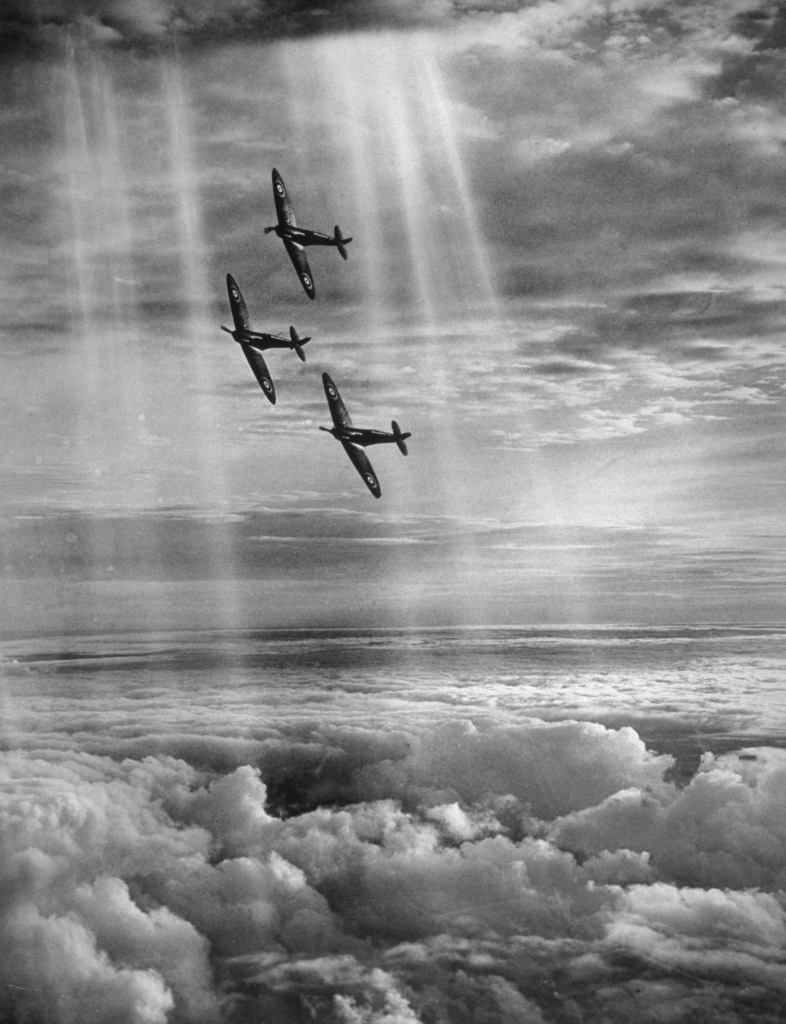
Spitfire’s flying in Vic formation.
Flying in Vic formation, three aircraft in a V shape with the leader at the apex, with Beaumont on the left of the flight leader and myself on the right… We were flying in a very tight formation earlier in the battle -until we learnt better. Unfortunately, a group of ME 109s spotted us and carried out an attack on our unprotected rear, which we had offered them on a plate. We ought to have known better. We knew it was vital to keep a good look out at all times, but were lulled into a false sense of security and had relaxed our vigilance briefly. After all, we had had our scrap, were nearly safely home and, anyway, we had no ammunition.
The first thing I felt was the thud of bullets hitting my aircraft and a long line of tracer bullets streaming ahead of my Spitfire.

Spitfire c1940.
In a reflex action I slammed the stick forward as far as it would go. For a brief second my Spitfire stood on its nose and I was looking straight down at mother earth, thousands of feet below. Thank God my Sutton harness was good and tight. I could feel the straps biting into my flesh as I entered the vertical with airspeed building up alarmingly. I felt fear mounting. Sweating, mouth dry and near panic. No ammunition and an attacker on my tail.
All this happened in seconds, but now the airspeed was nearly off the clock. I simply had to pull out and start looking for the enemy. that’s what I did, turning and climbing at the same time. As I opened the throttle fully, with emergency boost selected to assist the climb, I noticed wisps of white smoke coming from the nose of my fighter- God, No! Fire!
Suddenly the engine stopped. Apparently, a bullet in the glycol tank had dispersed all the coolant… So that explained the white smoke. The fuel tank of high-octane fuel is situated very close to the pilot in a Spitfire. The dread of being burnt to death was one of the worst fears. It drew heavily on any reserves of courage one had.
You can imagine by now, my eyes are searching wildly, frantically looking for my adversary, but as often happened in air combat, not a single plane was to be seen in the sky around me. The release of tension as I realised my good fortune is something that cannot be described. You only know what it is like to be given back your life if you have been through that experience.
The problem still confronted me, sitting in the cockpit of a battle-damaged Spitfire, seemed almost trivial in comparison with my situation a few seconds before. I experienced this feeling several times during the Battle of Britain and it had a profound effect on me, which remains with me to this day… Maybe this is what generated the anti-authority behaviour among us. It was no good telling us not to do a victory roll over the airfield when we returned from a scrap, because our aircraft may be damaged and might end up like strawberry jam in the middle of the airfield. This seemed a trivial risk compared with our experience of combat in battle.
The end of the episode was something of an anti-climax. I still had plenty of altitude and time to think. I prepared to bailout and began going through the procedure in my head: release the Sutton harness, make sure all connections to flying helmet are free, slide the canopy back, roll the aircraft until inverted, push the stick forward and out you go. Then start counting before pulling the D-ring. How many? My memory went blank. Was it three or ten? God! there is a vast difference between the two, I thought. Well, as long as the interval is sufficient to get clear of the aircraft before pulling the D-ring it should be ok.
During the soliloquy I’d got the Spit {Spitfire} into a steady glide. It was gliding rather like a brick, but handling reasonably well and responding to the controls almost normally. I surveyed what I could see of the damage rom the cockpit. Not much apart from a few bullet holed here and there, particularly the starboard wing. It worried me to abandon the old bus to certain destruction on to heavens know where, perhaps a school full of children. Besides, I was by no means convinced that the bail out procedure I had rehearsed was not without considerable risk. I could get caught up in the cockpit paraphernalia, I might be struck by the plane, or what if the parachute didn’t open? I convinced myself that was too bloody dangerous. I would stay with her and force land in a suitable field.
By now most of the fields were pretty small, so I decided it would be with the wheels up. I picked a field near Wareham that looked suitable, slid back the canopy and commenced an approach. At about 200 feet the boundary loomed up. Full flaps and a flare out near the ground achieved a creditable touchdown. So far so good. I was quite pleased with myself as the Spit slithered across the grass.
Then suddenly, I felt her going up onto her nose and, I thought, onto her back. With an almighty crash the canopy slammed shut over my head, the cockpit filled with dirt, completely blinding me. The aircraft seemed to me to be upside down and I was trapped. The awful fear of burning returned to full strength. I grabbed the canopy with all my might and threw it backwards. To my amazement it shot back easily, and the excessive adrenaline- boosted force I had used nearly tore my arms from their sockets. Now I could see the aircraft had finished up vertically on its nose, in a ditch I hadn’t seen from thre air.

My actions now became somewhat comic. It was obvious that I could easily jump clear and I commenced to do so without hesitation. To my utter horror I couldn’t move. Suddenly, I realised I was struggling against the Sutton harness, still buckled firmly in place. An instant pull release pin- I was free.
As I stood up my head was jerked violently backwards; this time it was my flying helmet still attached to the radio and oxygen sockets in the cockpit. Removing this final impediment I jumped to the ground, leaving my helmet in the cockpit… I stood back and took in the scene as locals arrived to convey me off to the pub in nearby Wareham and fill me with whiskey. I had a slight bullet graze to my leg, but was otherwise unhurt and felt strangely elated. The next day I was back on operations again.

Thinking back many years after the war
I must have sensed without realising the tracer from the German fighter was from the left to right direction. My instant reaction of stick hard forward causing the Merlin engine to belch smoke from the exhaust may have convinced the German fighter pilot he had been successful in his attack, or the sudden change in altitude of my aircraft caused him to overshoot. Also, ME109’s operating over the south coast far from their base in France were short of fuel and could not hang around for a lengthy dog fight or chase situation. We did not know about this fuel problem at the time and only found out many years after the war. To this day I don’t know why I put the stick forward.


After the war, Denis Robinson worked as a pilot for BOAC, British Caledonian and British Airways, before retiring in 1978 and died on 28 July 2015.

Wow! What a hair raising experience. Thank God he survived and was able to continue for the rest of the war. A true hero. Greatest respect for his service. May he RIP.
How many 22yo do we have today capable of maturity and the spirit to accomplish this?