“Victoria Cross should be a signal act of valour…not a single act”
Author and Military Historian Damien Lewis believes those overseeing Paddy Mayne’s Victoria Cross recommendation may have “misinterpreted” the regulations.
He told BFBS Forces News that the “inconceivable mistake needs to be corrected”.
George Peachment was the son of a barber and lived with his parents in Bury Lancashire. He
wanted to join the army and fight in the
war but was aware the minimum age for overseas service was 19 so decided to lie about his age. According to figures
compiled by the British Legion George Peachment was one of 250,000 young men
under the age of 19 who served in the Great War after claiming to be over 19
years of age.
On 19 April 1915, at the age of 17, he told the recruiting
sergeant he was 19 years old and one
month and wore his father’s bowler hat to make him look older and successfully
enlisted into the Rifle Corp, but his military service got off to a bad start.
Private Peachment was charged for being absent without leave
from 0700 hrs on 2 July 1915 until 0810 hrs 5 July and was fined seven days
loss of pay. Two months later he was confined to barracks for three days for
having a dirty bayonet whilst on parade. Six days later he was fighting during
the opening Battle of Loos, the largest British offensive on the western front
during 1915.
After four-days of artillery bombardments against German
lines at 0630 hrs on 25 September 1915 George Peachment took part in this major
offensive but the preliminary artillery bombardment had not silenced the German
machine guns, barbed wire defences were still intact and once in no man’s land
many British soldiers were cut down by machine gun and rifle fire from the
German trenches creating a scene of mass slaughter common throughout the Great
War.
Due to the large number of dead and dying caught up in
barbed wire defences and scattered across the battlefield, the line was retiring so it could be
reorganised when private George Peachment saw his company commander, Captain
Dubs lying wounded near the German trenches. Instead of falling back or taking
cover with other men in a shell hole, Peachment whilst under intense machine
gun fire crawled towards Captain Dubs.
In 1996 Lord Ashcroft bought Peachment’s Victoria Cross at auction along with a remarkable letter from Peachment’s company commander to his mother which tells the story of how her son died saving his life. Captain Dubs wrote:
“I cannot tell you how sorry I am that your brave son was
killed, but I hope it may be some consolation to you to know how bravely he
behaved and how he met his end…
When we reached the {barbed} wire we found it absolutely
untouched by our artillery fire and an almost impossible obstacle as a result.
However, we had to push on and I gave the order to try and get through it and
over it. Your son followed me over the wire and advanced with me about 20 yards
through it till we were only about 15 yards from the German trenches. None of
the other men of the line were able to get as far and he was the only man with
me. As a matter of fact, I had not noticed your son with me, but at this point
a bomb hit me in the eye blowing it and part of my face away.
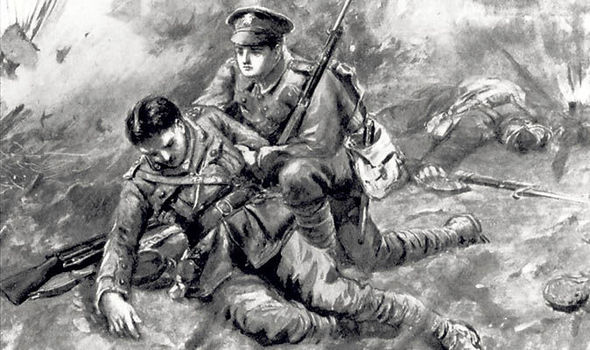
I fell to the ground, but on sitting up found your son
kneeling beside me. The German fire at this time was very intense but your son
was perfectly cool. He asked me for my field dressing and started bandaging my
head quite oblivious to the fire. His first thought was to help me, and
although there was a shell hole nearby where he might have got cover, he never
thought of doing so.
Of course, the Germans were bound to see us sitting up,
and one of them threw a bomb which hit your son in the chest whilst at the same
time I received a bullet in the chest. Your son was beyond feeling any pain
though still alive. I tried to drag him into the shell hole and at the same
time keep him from moving, but at that moment a bullet hit him in the head and
killed him.
After his first wound he was bound to die, in fact he was
already, immediately after he received it unconscious of any pain. I lay beside
him there all day, and eventually we were picked up in the late afternoon when
the trench was taken by a flank attack.
I can’t tell you how much I admired your son’s bravery
and pluck. He lost his life in trying to help me and no man could have been
braver than he was… I have recommended him for the Victoria Cross and have
heard the commanding officer has seen the recommendation.
If he gets it, it is sad to think he is not in this world to receive all the congratulations he would get, but perhaps it may be of comfort to you… Your son died the finest death that man can die, he showed the greatest gallantry a man could show, and I hope these facts help you in your sad loss together with the fact he was spared all pain and suffering.”
IWW
Official Citation
published in the London Gazette 18 November 1915
“During heavy fighting when our
front line was compelled to retire to reorganise, Private Peachment, seeing his
company commander Captain Dubs lying wounded crawled to assist him. The enemy
fire was intense but though there was a shell hole quite close in which men had
taken cover, Private Peachment never thought of saving himself.
He knelt in the open by his
officer and tried to help him but while doing this he was first wounded by a
bomb and a minute later mortally wounded by a rifle bullet.
He was one of the youngest men in his battalion and gave this splendid example of courage and sacrifice. “
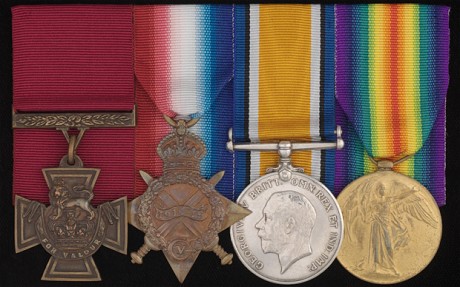
Pte Peachment’s medals (Ashcroft Collection)
On 29 November 1916 the Victoria Cross
was awarded to his mother by King George V at Buckingham Palace. His body was
never recovered but he is commemorated on the Loos memorial which lists the
names of more than 20,000 British and Commonwealth soldiers who died during the
battle.
Third Supplement to The London Gazette of 16 November 1915.
18 November 1915, Numb. 29371, p. 11450
Name: George Stanley PEACHMENT
D.O.B: 5th May, 1897
D.O.A: 25th September, 1915
D.O.D: 25th September, 1915
Award: Victoria Cross
Occupation at time of action: Private, 2nd Battalion The
King’s Royal Rifle Corps, 2nd Brigade, 1st Division
 Alan Malcher